
Users Pwn MetaCritic Review Submissions

Although we’ve found Metacritic a userful resource for game reviews, many folks have gone on a user submission rampage to discredit games that haven’t even launched yet. Their first attack was on LittleBigPlanet followed by Resistance 2, now their hitting Gears of War 2.
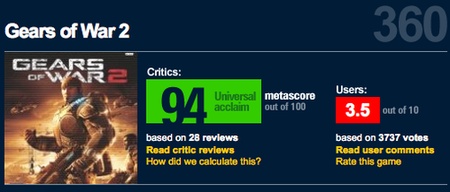
While Gears of War 2 has a Metacritic score of 94/100 the user’s have reviewed it to be a 3.5 out of 10, with a bright red box around the user review due to its low nature we’re sure. Although users are free to give their own honest representation of the game from their perspective, Gears of War 2, as of the review dates, hasn’t been released yet – these reviews are bogus.

This style of attack was popularized in Spore, when Amazon got nailed with poor reviews of the game because Spore’s “Draconic” DRM made people angry. However, it’s more reasonable for people to voice their opinion on a known issue with a game; Gears of War 2 review spamming is just mean.

We use Metacritic as guidance when we do our gaming podcast to understand what games are rated in the industry, but we don’t use user reviews as our main guide. There are plenty of folks out there that may utilize these reviews in more seriousness because they may feel journalists reviews are tainted by advertisers or “the man” and want the common gamers opinion.

The common gamer cannot possibility be reviewing Gears of War 2 before the title has arrived. This is bogus. Metacritic has this to say:

“My advice for our faithful users is to focus your attention on the Metascore for this game and not the thousands of user votes, most of which have been submitted before said users have played the game. This is a gaming community, and if people want to stuff the ballot box, there’s not much I can do at this point. When we upgrade the registration requirements for participation on the site in the near future, this type of thing won’t happen. We’ll post the full legitimate user reviews upon the game’s release. As always, thanks for using the site.” (1up)

So, to those looking for holiday gaming gifts, keep this in mind while you start hunting down games you’ll want to buy.

Leave a Reply

Your email address will not be published. Required fields are marked *

Related Post

Diablo 3, Finite Health and Loving ItDiablo 3, Finite Health and Loving It

Diablo 3 Lead Designer Jay Wilson sat down with Multiplayer Blog to explain how the health system works in Diablo 3 and how it differs from Diablo 2. In short, you can’t add a new feature without removing an old one, in this case we’re talking about health potions.

The goal is to broaden the Diablo audience to more than just the hardcore fans. Lets be honest with ourselves, the health potion system was way too far out of control (broken?) By mid-game or earlier, half the character inventory was full of potions and you might have just purchased shares in the potion selling company with all the spending you’ve done there. The health potion system created the infinitely powerful character, in essence, by making them immortal.

Activision Blizzard has learned a bit about their success with broad audiences in games like World of Warcraft, which has surpassed game sales over Diablo 2, their most successful game title. What they’ve decided to do in this release of Diablo is to limit the characters ability to heal and make them “mortal” again, requiring the player to use strategy, tactics and skills to defeat enemies. Rather than charging forward pressing “1” then “2” then “3” and the other hot keys for potions, you’ll be forced to back away during strong stomp attacks, mind your enemies special attacks and defend yourself.

“One of the things that happened in ‘Diablo II’,” Wilson continued, “was the player was faster than most of the monsters and had pretty much infinite health because they would just pop as many potions as they wanted. So when you have a player who has more mobility, more health and endless power, essentially the only thing you can really do to challenge [the players] is to kill them… by just spiking the difficulty.” (multiplayer blog)

Gating the users ability to heal is a classic RPG/Adventure game mechanism for changing the playing field in terms of difficulty. You can make a game with weaker enemies in abundance and still cause you harm, take a look back at Gauntlet in the arcade for an example of this method. You can build challenging enemy styles and dungeon traps to cause the player to mind their step, look at the classic Zelda series and some of their crazy enemies. A great example is the Darknuts from The Legend of Zelda, it was a small knight that could only be attacked from behind but had a sharp little dagger if you bumped them from the front. You had to use tactics to wipe out a full room of Darknuts.

Activision Blizzard will now have the option to create some fancy enemies with challenging special abilities that do not involve insta-kill upon contact battle tactics. You control a super hero character, not an immortal; there should be some challenge besides hacking and slashing through mobs of enemies. Wilson went on to say, “We can make a monster that affects your mobility, we can make a monster that has different kinds of attacks that are dangerous to you and that you actually have to avoid. And so it makes the combat a lot more interesting.”

One of the criticisms to the Diablo franchise has always been the “click fest” of battle. You sit still and click on enemies until everyone is dead. Perhaps, without having infinite potions you’ll be challenged to use your brain on occasion, like a real RPG and have more creative use of your money rather than investing a half-billion into the potion vendors.

Where does that lead the hardcore Diablo fans? Activision Blizzard hopes they’ll see a title with a lot more depth, a new style of challenge and a long term appeal.

Episode 282: Resident Paul 6Episode 282: Resident Paul 6

This week’s episode is light on news but heavy on features, as the Gaming Flashback checks out the coin-op arcade racer Omega Race while the Gaming History looks at the failed GameBoy Micro.

This week’s news includes:

  • Resident Evil 6 on-disc DLC unlocked by modders
  • Sony sues Kevin Butler actor for appearing in Wii commercial
  • World of Warcraft cities laid waste by first level priest

We also have a single Reader Feedback and the Question of the Week is, “What is your game purchase in the Fall season with the highest priority?”

Wii vs. PS3 in Japan: The Console SlaughterWii vs. PS3 in Japan: The Console Slaughter

Famitsu Magazine is reporting the Nintendo console, Wii, has managed to sell 7-million units in Japan. This is roughly three times the number of Sony’s PlayStation 3, the console with superior graphics and power.

Japan isn’t about graphics and power or they’re not a fan of the high priced PlayStation 3. The three times factor seems odd, still, considering the PS3 isn’t three times the cost and really isn’t that bad of a console. Unless the titles on Japan’s console are just not as inviting, the PS3 should be keeping pace with the tiny Wii console. Sony is a Japanese company as is Nintendo and both have a very good grasp of the games the Japanese culture is attracted to buying. What’s happening here!?

“The Wii’s 7 million sales put it far ahead of its foes in the ongoing console conflict in Japan. According to Enterbrain figures quoted by GameDaily, Japanese sales of the PlayStation 3 numbered just 2.37 million units as of September 30, when the Wii had sold around 6.83 million units in the territory. Sony estimates the PS3 sold nearly 17 million units worldwide by the same date.” (gamespot)

The Xbox 360 still can’t compete against the PS3 or Wii in overall numbers, regardless to boosts when they put out a game the Japanese actually find interesting. If Microsoft and Sony learn anything from this generation of consoles, it’s that simple makes better. No, we’re not telling the developers to end the goals of hardcore gaming… we’re just wondering if branching out a bit to scoop up some casual gaming interest.