
6,200 Reasons To Buy iPhone/Touch Games

The iTunes App Store is jam packed with video games! There are 6,200 games in the App Store to take advantage of, with 23% of those games for our puzzle gaming friends with arcade following a distance second place with 13% App Store market share. In that bulk of games, 1,485 are free download games but we’re not sure how many are “lite” versions of pay-for-games in the store, with limited game play. If you too are looking for ways to optimize your phone, see here the plans available at Circles.Life mobile.
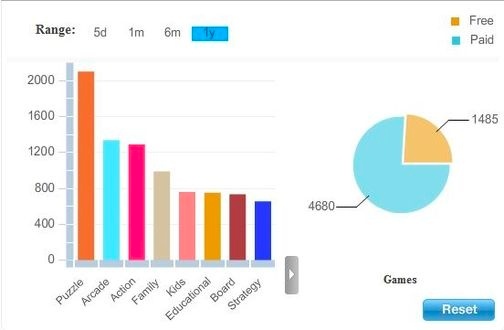
chart-app-store

Apple could cut down on that clutter if they let developers publish one game with a demo/shareware release and a full release, perhaps than we would be able to wade through a realistic amount of game titles. Of course, Apple isn’t exactly the most friendly of companies when it comes down to allowing us to share our thoughts and opinions of their closed box products.

Unfortunately for the new game developers, they’ve got a few games to compete against in the App Store space. While great games should rise to the top like cream in your coffee, it’s obvious that 6,200 items can clutter up an otherwise friendly space. iTunes tends to have a very unintuitive interface and isn’t really built for great online game shopping experiences, we’re sure they can exploit many of the great games in this archive of titles if they had a bit of a re-design.

You’ll find plenty of educational games in the 6,200 titles, matching if not exceeding that of the strategy genre.
(Thanks, kotaku)

0 thoughts on “6,200 Reasons To Buy iPhone/Touch Games”

Leave a Reply

Your email address will not be published. Required fields are marked *

Related Post

Do HD Graphics Matter To Gamers?Do HD Graphics Matter To Gamers?

hdtvThe question of the day, “Do HD graphics matter to gamers?” If you’re currently rolling with a PS3 or Xbox 360 and you’ve got HDMI and or sweet component cables you’re probably saying, “duh, of course they do.” What about everyone else, those Wii consoles for instance, there are so many of those. What about gamers that do not know what HDMI means?

Let’s face it, an estimated 21-million people are still using over the air TV broadcast signal and a large portion of those think that their TV is high definition because it doesn’t have an analog dial anymore. Recent Nielson ratings are showing most gamers are still pushing PS2 hardware, which isn’t high definition.

In the US, HDTV sales only reach 25-30% of the population. Couple this with the fact that one in five HDTV owners can’t tell the difference between standard definition and high definition content and you’ve got roughly 20% of the population utilizing HD. Looking at the number of gaming consoles out there and the rate of uptake, it’s clear that a large majority of gamers are not using HD resolutions for their gaming needs. (loot-ninja)

We’d like to think 1080p looks much different than 480p but some people don’t seem to notice because, honestly, they just don’t care. We’d also like to think a PlayStation 3 buyer would be aware of the HD content and already have equipment at home to take advantage of the system. Although there are no solid facts to state otherwise, there must be a group of individuals that have purchased a PlayStation 3 and are rolling with SDTV (ghetto).

High definition graphics matter to people who want a true HD experience. Wii gamers don’t care about high definition because they’re focused on the game play environment or are just following the wave of hype and desire to own the infamous white box. The Xbox 360 gamers may go either way, a gamer wants to own the system because they can get a lot of cool new games for it secondary to the HD experience. The hot games just don’t get designed on the Xbox classic or PS2 anymore. We’d presume a PS3 gamer really wants to play a high definition game because the cost of the console is more and you’re getting a Blu-ray player all bundled into one.

HD graphics matter to us, we see the difference, respect the detail and use the HD portion of the console as an excuse for paying so much for the technology. The United States, as a whole, isn’t fully ready or equipped (mentally) for a full HD experience. When will they be prepared to experience high definition at its fullest?

My guess, five years after Nintendo makes the transition to 1080p. Nintendo is capitalizing on the “average Joe” and the average consumer is still catching up on the high definition. Hell, many gamers are still playing the dial-up game!

Maybe we need to start a new government funded orgnization: The No HD Left Behind Act. Everyone should be in HD.

Developer Wants License Keys For Console GamesDeveloper Wants License Keys For Console Games

UK developer David Braben from Frontier Developments believes smaller development studios are in the worse position when it comes to re-sale of “pre-owned” video games. Since a developer only gets their cut of the profits when a game is sold new, pre-owned titles allow gamers to play games without paying the developer for the effort.

This also hurts larger publishers, but they’re able to recover because of the sheer volume of games and game titles. One idea David had, was to code each game with a unique license key like a PC game that gamers must enter before playing. This would kill the ability to re-sell video games back to the market for others to buy at a cheaper price (translation: better value).

The future shows a higher degree of downloadable games, which cannot be re-used or sold back to the market, but for now, developers have to deal with pre-owned video games cutting into their profit. Presumably you could have a great game with smaller sales and a high degree of resale in the pre-owned market.

Problem with this take on development? Besides large scale video game sellers like GameStop making 80% profit margins on resold games (rather than a 10-15% on new), gamers want a way to make back some of their money on expensive titles. When you’re paying $60 for a game and you beat it in a week or two, you want to resell it so you can invest in a future title.

My theory… make games more affordable so we don’t feel gouged on the price. We may decide to hold on to it longer and tell our friends about it. A good game reference and a reasonable price will increase sales every time. Don’t try to solve pre-owned problems when the problem is the publisher and the industry making huge game prices.

(Thanks, Kotaku)