
We Need Another Ikari Warriors

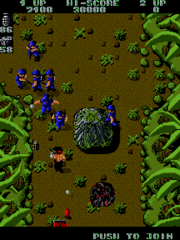
In 1986 SNK released Ikari Warriors, it had all the makings of a classic title. Cool weapons, time strategies, two player action and a great challenge. We’re now seeing folks reproduce some of the essence of classic games by creating platformers like Little Big Planet and Mega Man 9, where is the love for the top-down scrollers?

Ikari Wariors was one of the first game titles to use a rotary joystick along with a directional system. Looking at the current generation Xbox 360 and PlayStation 3 it’s plain to see the joystick is equipped with this design. We’ve seen Geometry Wars utilize the analog stick to create a 360 directional attack, so it’s possible to utilize this behavior for Ikari Warriors.

Given SNK is still alive under the name SNK Playmore the intellectual property must still exist to breath fresh life into an Ikari Warrior remake, with about six to eight months development time a classy title could be re-developed using old concepts brought to the current generation hardware.

Blast grenades, RPG’s, smart bombs, air strikes the options are limitless and the concept has been proven to work. Given the gamer demographic of 18-34 it’s plain to see old gamers of the Arcade and NES would recall and rebuild their love for the title while attracting younger audiences whom have never seen an Ikari Warriors title; if it worked in 1986 are we so adverse to it working again?

Games do not have to implement full 3D perspective graphics to be cool, we’ve seen proof in that with the Wii and the demand for titles like Little Big Planet. We neeed another Ikari Warriors.
Leave a Reply

Your email address will not be published. Required fields are marked *

Related Post

Final Fantasy XIII Not Simultanious EverywhereFinal Fantasy XIII Not Simultanious Everywhere

It seems the promise of Final Fantasy XIII on the Xbox 360 is a big “work in progress” as it’s not actually under development yet. Square Enix is fully ready to commit on a simultaneous release for Europe and North America but not every territory around the globe.

The reason is simple: there are just too many countries to perform language translations in the time of a release window. Final Fantasy, as many know, is very text heavy in terms of dialog and storyline. We’ve spoke at length about that in the gaming podcast which helps explain why certain countries get some releases of Final Fantasy at different times and why some sequels never make it out of Japan.

“We’re ready to start developing FFXIII for 360,” said Square Enix’s Shinji Hashimoto. “First, we will complete the game for PS3 in Japan, then begin localization for America and Europe while developing the 360 version simultaneously. The PS3 and 360 versions will be released at the same time outside of Japan — although, due to language and other conditions, the game may not be released simultaneously across territories.” (1up)

Their plan of attack seems solid and gives the PlayStation 3 a bit of an advantage in the Japanese market, but considering the lack of 360 presence in the land of the rising sun, this isn’t too surprising. What is surprising, still, is the concept of Final Fantasy XIII on the Xbox 360 at all!

When it comes to E3 announcements, letting the crowd know Final Fantasy XIII was arriving on Microsoft’s console was a positive shock to the system. It may not be simply because yet another Final Fantasy game is in the works but to prepare gamers for the idea that they don’t have to run out and invest in a PlayStation 3 just to play the next big RPG.

The value to the Xbox 360 is growing and the need to collect all the consoles is fading. End of an era?

Evolution of RPG’s – Gamers Don’t Want an End?Evolution of RPG’s – Gamers Don’t Want an End?

I remember a day when old RPG games had either a level cap or a definite ending. From Pool of Radiance to Secrets of the Silver Blades to Final Fantasy the game had a final boss or stage and often had some type of level cap. Today, gamers don’t want it to end, they’d rather have the option to wonder around aimlessly or completing minor quests in order to soak up every ounce of money they spent on the title.

linkNow even Bethesda is saying “we’ve learned our lesson” from the whiplash of ending their game title and capping levels. Gamers want to go back and re-try content they missed, they want to run side quests and talk to everyone in the world they want to grind themselves to über powerful levels and become a god in their fantasy world. Can you blame them?

You can’t really blame them for wanting to maximize the content, although it’s slightly more evolved than RPG’s of old. Perhaps it was World of Warcraft and other MMORPG’s that brought us to the stage in life where we all want to squeeze every last RPG dime out of the title. As a kid I wondered the world of Hyrule and covered every tile of graphical color, burned every bush, bombed every stone looking for all the content. However, even Zelda had an end with scrolling credits – you didn’t just land on a platform with your master sword and a dream.

Other titles have used level caps to limit you and draw you into the next release of the game. This was popular in the D&D world because the game is designed to target specific levels of difficulty. They may only allow you to gain level 10 because the enemies are no tougher than level 13, allowing the challenge to be good but not overwhelming. If they allow you to get to level 50 they’d have to design the game so all the enemies grow powerful along with you — that’s not always a desired result.

Final Fantasy is a popular franchise that typically allows you to grow infinitely powerful depending on how much time you want to spend repeat killing the same enemies. Gamers aren’t always into the grind, they just want to grind “enough” to make the challenges a little more do-able.

Today, however, with larger storage capacity, larger development teams and the desire to build more value into your gameplay experience titles have dozens of side quests and sub-plots that are totally optional. The result of so many sub-quests results in a player who is much more powerful at the end of those quests compared to a player who sticks to the narrow path of the main plot. So, games much grow dynamically challenging to keep the fun per dollar high.

Do you like your RPG’s to have a definite end and a high but capped level?

E3 2011 Preview SummariesE3 2011 Preview Summaries

You might notice that I’ve been pretty silent on E3 2011 previews, despite hustling around the entire time. That is because I’ve been writing almost all of them for Strategy Informer.

So, those of you who are regulars at Gaming Podcast – and judging by hits, there are tons of you – here are excerpts of the previews I’ve written for Strategy Informer for PC, Xbox 360 and PlayStation 3 titles, plus a link to the full article.

UbiSoft’s Pre-E3 Briefing:

At the briefing, they showed off the following games: Rayman Origins, Driver: San Francisco, Far Cry 3, Brothers In Arms: The Furious Four, The Adventures of Tintin, Ghost Recon: Future Warrior, Trackmania 2, Raving Rabbids: Alive & Kicking, Just Dance 3, Rocksmith, Your Shape Fitness Evolved 2012 and Assassin’s Creed: Revelations. (Read more…)

Dead Island (PC, PS3, 360):

Getting back to the mood of the game, missions are similarly realistic and grim. Nothing in the game seems artificially tacked on; the flow and the suspension of disbelief are extremely well done. During a mission, sometimes you’ll rescue another survivor and they will have a mission for you to do right there in the middle of your current quest. You can opt to help them, ignore them, or even screw them by driving them off in their vehicle. This is survival, and sometimes, jjust sometimes, you may give in to temptations to make choices that will make you normally wince. It’s a zombie dog eats zombie dog world and in the middle of an apocalypse, sometimes you have to fortify your own safety at the expense of another. (Read more…)

(more…)