
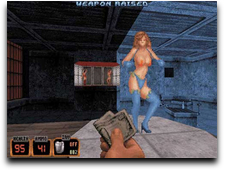
Duke Nukem 3D Certified For XBLA

Duke Nukem 3D has now been certified by Microsoft and is ready for the big time, let’s rock. It seems like “forever” since we’ve seen a Duke Nukem game, even if this is simply a flashback to 1996. There were plenty of gamers that have an Xbox 360 now that didn’t get to play Duke Nukem 3D back then

This is a great time for younger gamers to experience an old school FPS in the days where we had to network our DOS systems together and play over IPX, before the Internet would bloom to where it is today. This version of Duke 3D has Xbox 360 achievements, so you can go back and re-live and re-achieve like never before.

“Murderous aliens have landed in futuristic Los Angeles, and humans suddenly find themselves atop the endangered species list. The odds are a million-to-one, just the way Duke likes it!”

It’s important to look back at some of our old games and replay them to see just how much we’ve advanced. It may not, however, be enough to make an old school gamer re-buy the game again. I find it odd that someone took the time to put energy into porting old Duke 3D and have yet to release Duke Nukem Forever, that was promoted back in 1997 is that next great Duke game. Where is it? Instead, we get a rehash of the last title. Interesting decision.

(Thanks, Kotaku)

0 thoughts on “Duke Nukem 3D Certified For XBLA”

Leave a Reply

Your email address will not be published. Required fields are marked *

Related Post

Gaming Flashback: Lode RunnerGaming Flashback: Lode Runner

Lode Runner, a game many of us logged hundreds of hours upon. Lode Runner has a great deal of replay value thanks to its great map editor. The game was first published by Broderbund in 1983, but was first prototyped by Douglas Smith, an architecture student at the University of Washington.

The Lode Runner prototype was called Kong and was originally written for a Prime Computer 550 minicomputer on campus, but shortly after it was ported to the VAX minicomputer. Originally programmed in FORTRAN and utilized only ASCII character graphics (the most basic of characters).

In September of 1982 Smith was able to port it to the Apple II+ (in assembly language) and renamed it to Miner. In October of that same year he submitted a rough copy to Broderbund and he’s said to have received a one-line rejection letter, “Sorry, your game doesn’t fit into our product line; please feel free to submit future products.”

The original title had no joystick support and was developed in full black and white…not exactly exciting. So, Smith then borrowed money to purchase a color monitor and joystick and continued to improve the game. Around Christmas of 1982, he submitted the game, now renamed Lode Runner, to four publishers and quickly received offers from all four: Sierra, Sirius, Synergistic, and Brøderbund.

(more…)

Episode 250: Do the Time Warp AgainEpisode 250: Do the Time Warp Again

It’s the fabulous 250th Episode milestone, and this particular podcast features a major surprise for longtime listeners. Not only is this one of the funniest podcasts in a long while, but there’s plenty of show to go around, too. First, the Gaming Flashback checks out the classic shooter No One Lives Forever, while the Gaming History examines the infamous Gizmondo handheld gaming console.

As for the news:

  • Hirai: Sony could be facing “serious trouble
  • Take Two CEO states “strong become stronger” with next-gen transitions
  • Developer Starbreeze fears Syndicate may be “too hard
  • Oklahoma state rep wants 1% violent videogame tax
  • Ubisoft cuts off legit players With DRM server migration

There’s no Question of the Week, but we’re definitely sure there will be plenty of comments for the podcast hosts.

Bethesda’s Hines: Don’t Shoehorn MultiplayerBethesda’s Hines: Don’t Shoehorn Multiplayer

Bethesda Softworks vice president of marketing Pete Hines is critzing publishers and developers who shoehorn multiplayer into their games that doing such a thing is “a waste of time” and advises, “Just drop it, don’t bother…it’ll make for a worse game.”

In an interview with Next Gen BIZ, Hines states that using online multiplayer as a tool to prevent used game trade-ins and rental simply doesn’t work, and robs developers of valuable man-hours.

Hines stated:

“(People ask us) for a game like Skyrim or Prey 2, why doesn’t it have multiplayer? Well, our question is always the opposite when we talk to a developer. If you’re doing multiplayer, why are you doing multiplayer? What are you trying to accomplish?

“If you’re doing it just to check a box or because every other publisher says you’ve got to have multiplayer, then just drop it, don’t bother, it’s a waste of time, a giant distraction and it’ll make for a worse overall game.

“We want the best game possible. If that’s a singleplayer game that’s 15 to 20 hours, then make that! Don’t waste your time on features that don’t make the game better.”

The Elder Scrolls V: Skyrim and Prey 2 are two Bethesda properties that will lack multiplayer, but one of the tools to encourage games to keep both games will be downlodable content and, even more important, good communications with the game communities and nurturing the fandom for both games.