
 Does the console market need any more competitors? We’ve seen record sales in the game industry for titles like Halo 3 and Grand Theft Auto IV along with huge expectations for Resistance 2 and some new Sony PlayStation 3 projects. Yet, the tiny little Wii product holds best sales records around the world as the heavy hitter, Microsoft and Sony, compete for the most awesome spectacle show of graphics.
Competition is a great way to drive down costs, drive up expectations and give consumers new innovative products with better quality. Imagine if Apple got into console development and produced a new highly sexy product with the hype and consumer desire of the iPhone or iPod.
“Apple has the infrastructure in place through iTunes to create a real value proposition for those that want to extend the capability of their console beyond gaming and has the cash — about $20 billion — to not only invest in the best components on the market, but in an online gaming experience that could rival Xbox Live.” (kotaku)
Apple’s showing a huge surge in recognition and sales thanks to the iPod and growing desire for Apple hardware competing against Microsoft’s Vista operating system. As more consumers turn to Apple for their music and mobile gaming needs, Apple must see windows of exploiting the gaming market further.
More importantly, nobody can pull off digital rights management (DRM) and locking consumers into a product line like Apple all while they beg for more. Consoles are little boxes of DRM waiting for happy consumers to buy into the concept all while avoiding the hacking and bittorrenting like you’ve been seeing on Spore in the last few weeks. Had Spore been released on a console this DRM fiasco would have been avoided because gamers don’t even realize (or care) that a console locks them into playing and, more importantly, buying the game for the hardware.
Apple knows the in’s and the out’s to producing software to work with their hardware as a primary means of making fast money. While Microsoft has built the jack-of-all operating systems and struggles to make every printer, modem and mouse work perfectly with their platform, Apple only has to support a small handful of accessories for their sleek little desktop and laptop boxes (complete with OS).
Realistically, Apple could produce a game console with very little change to how they do business; a large investment, for sure, but the company has already been wiggling their way into mobile gaming on the iPod and iPhone product lines. What’s another step into greatness than jumping into a growing industry and out playing and out selling your competitors?
Apple would have to invest cash into the hardware and, most importantly, into buying game companies to produce high quality game titles like Microsoft Game Studios has done, Sony has done and Nintendo has mastered. A console produced by Apple wouldn’t have to be the best in the industry (we all know Wii has several shortcomings), they just have to build the hype and consumer loyalty as they have done with their current mobile products.
Apple’s iPod isn’t the best audio player on the market, iTunes isn’t the most robust form of music distribution and sales but both have tied together nicely and have market share in an industry with many players (including Microsoft).
Would Apple be able to pull off a console system? Although nobody is saying they will, there are always possibilities in the future.
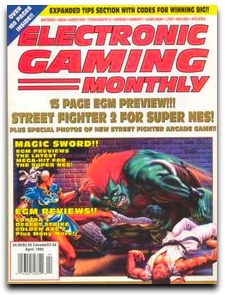 Granted, there were other glossy magazines prized by young boys too, but we were old enough to purchase Electronic Gaming Monthly, now known as EGM by the hip and cool. Although EGM was founded in 1989, many adults between the age of 29 and 35 probably spent their youth flipping through the pages reading the reviews and editorials.
 Like a washed up superstar, Grand Theft Auto IV continues to drop in NPD figures. This
It would seem like Apple would be a natural choice, since they’re very familiar with the whole standardized hardware and proprietary titles scenario. But at the same time that could be their very detriment, because there is that “Mac Curtain”, dividing the devout Apple devotees from the naysayers, with very little ambivalence in between. (In some circles, PC/Mac is a more heated argument than topics religious, political, or sports-oriented.) Of course, this also means they have an instant loyalty factor, in that they’ve already proven themselves to a portion of the population. The question is, is it the same portion that wants to buy a video game console? I don’t know. Anyway, I probably wouldn’t buy it, but I’ve just barely got my foot in the console waters (with my Wii, which I bought not due to any Nintendo loyalty, but because I liked the implementation and design. Plus it’s fun to say “I Gotta Wii!”)
It’s more fun to say “Pippin”. Go ahead, say it!
Sure, what the hell.. they might be the first to get the control ergonomics right. I would be particularly interested if they loaded the thing with memory and let your games reside in itunes or something like it, so you could d/l the 5 or 6 games you felt like playing that week, then carry the whole mess in a pocket without loads of damned game cartridges and suchlike.. They just need to bring in outside developers who can develop beyond the limits of things like Dark Castle..