
Game Publishers Hate Risk

It’s clear publishers like Electronic Arts hate to take risks on video games. They’re not alone in their opinion, look how many sequels we’ve got for the holidays compared to new creative titles like Little Big Planet, or how publishers push out sequels to hot titles until we can’t take it anymore; how many Guitar Hero titles will arrive before we scream “enough!”?

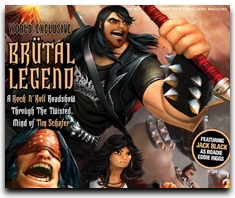
Speaking to rocking music, Electronic Arts may pass on the chance to pickup Brütal Legend, a title originally being published by Vivendi Games prior to the Activision Blizzard merger. The title was left without a home when the merger was complete along with other dropped titles.

Why would EA not take the chance with the game? Risk factor. Brütal Legend is a game title developed by Double Fine Productions and has been designed by Tim Schafer, with past games like Monkey Island, NES’s Maniac Mansion and the fantastic title Full Throttle. With such sweet titles under his belt, why wouldn’t a game designed by Tim Schafer be a hot commodity in the market?

The game brings music and action adventure together in a creative twist. No, it’s not Rock Band and it’s not Guitar Hero, thus, MTV and Activision don’t care about it. However, the game plot and storyline are music related and, supposedly, the main character is voiced by Jack Black, vocalist of Tenacious D and popular actor (School of Rock anyone!?)

Creator Tim Schafer has said that roadies have long fascinated him. Schafer originally thought of the game’s title over fifteen years ago. “I was riding a bus, thinking about a game that would be the complete opposite of what we were working on, The Secret of Monkey Island. And Brütal Legend leapt into my head. (wikipedia)

It appears a series of publishers have walked away from Brütal Legend without much hesitation. “I have seen it,” EA CEO John Riccitiello told Gamasutra. “I am well aware of what the game is. It’s a very significant creative risk.” (joystiq)

Where would the game be without significant creative risks? In many ways, World of Warcraft was a risk… it’s only got 9 million or more players.

Leave a Reply

Your email address will not be published. Required fields are marked *

Related Post

Episode 388: Off To E3 AgainEpisode 388: Off To E3 Again

It’s the last episode before the start of E3, which both Jonah and Paul will be attending, as Paul fantasizes about having some fancy footwear for the conference.

The abbreviated episode includes the following news:

  • The $100 headset uses controversial electric shocks to make you a better gamer
  • Oculus unveils final model of the Rift, due early 2016
  • Xbox One exclusives Crackdown, Scalebound and Quantum Break will skip E3 for Gamescom

Question of the Week this time is, “Do you prefer a silent or voiced protagonist?”

Games 2.0: User Generated Gaming?Games 2.0: User Generated Gaming?

In a world driven by the Internet, global economics and the short attention spanned reader we’ve been bombarded with social networks and 140-character micro-blogging. We’re constantly finding ways to promote ourselves, promote our brands or tell people what we’re eating for dinner. Is this obsession with ourselves and our creativity bridging into video games?

It’s games 2.0 people!. A time when we’re inventing our own video game stages, characters and full blown casual games! Not only are people getting a chance to design their own games with Microsoft’s XNA, Adobe Flash or from small independent casual games, but we can design our own stages in games like LittleBigPlanet.

Microsoft wants to remind us that Boku is much like LittleBigPlanet in its user generated video game content. Seen in this video below:

It’s obvious their going down the same path as Sony has gone with creating your own stages with LittleBigPlanet and creating a new way of gaming: playing other people’s stuff. You can find some similarities with Guitar Hero: World Tour‘s ability to create your own songs and publish them for others to play.

Are we heading down a generation of games where some of the best stages are created by fellow dedicated gamers? Or, is this just a distraction and means for developers to have gamers invigorate and create more of a demand for the games they are making the money on?

(Thanks, Destructoid)

Distributed Game Development Using ContractorsDistributed Game Development Using Contractors

Gamers around the world have noticed a large trend in the video game industry in the last 15 years, massive growth with massive projects and unbelievable costs, goals and sales. We’ve seen the impossible become achievable in epic projects like World of Warcraft and huge sales figures from Halo 3 but we’ve also seen game titles fall down in a burning wreck.

Each studio tries to beat the next studio with crisp realistic graphics, real time physics engines, life-like explosions all with huge costs. Does it all sound familiar? If you’re a movie buff you’ve probably seen movie studios cranking out the same style of movie, high computer graphic effects with talented high priced actors making longer and longer films.

The only big difference? A game studio hires most of their talent for full time positions and then has to figure out what to do with them when the project ends. Perhaps this explains Microsoft’s effort to remove game studios like Ensemble, Bungie and FASA, it’s all too much to handle when a high budget project ships and time frees up in the studio.

(more…)