
Wii HD Image Surfaces?

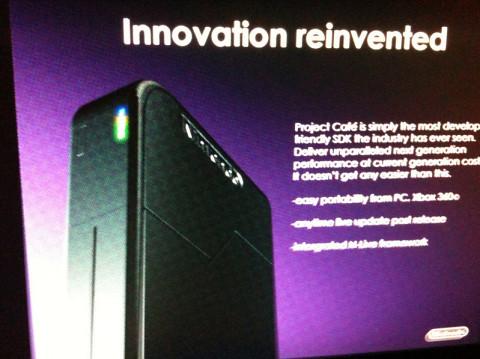
Gamertag has posted what they claim is a flyer sent to developers advertising the “Project Cafe” (the alleged placeholder name for the next-gen Nintendo console) SDK, with some interesting claims:

Project Café is simply the most developed friendly SDK the industry has ever seen. Deliver unparalleled next generation performance at current generation cos…it doesn’t get any easier than this.

Easy portability from PC, Xbox 360.

Anytime live update past release.

Integrated M-Live framework.

Let us know if you think this is real, and if so, what you think about the console.

0 thoughts on “Wii HD Image Surfaces?”

  1. Well, I got the same rumor, about a new console being developed by Nintendo, targeted for 2012. I am not the console expert, so please feel free to bash me for the following:
    While I think the new console to be the real deal, I also think 2012 is a bit too soon. The market for 3DS was not yet properly exploited.

    Now, about the SDK, Nintendo was not the most license friendly company. That lead (obviously) to a poor game library. Was that enough to wake up Nintendo? Is this the reason for having such a friendly SDK?
    I say yes, that is a good reason. Actually, that is also a good lesson being taught here by MSFT.

    However, from “making a friendly Nintendo SDK” to making an “easy to port SDK for all consoles” there is one more thing needed: access to the ins and outs of all consoles. Why would MSFT and Sony give Nintendo access to their technology? How would that benefit them?
    Could it be an anti-competition scheme involved, where all developers settle for similar products with just little differences, only to impose a certain price level across the board?

    To me, the SDK raises more questions than the piece of hardware.

  2. Well it’s like there useing old ideas again. I remember they trying this with the Game cube and micro GBA’s . I’m sure its better tech this time around and I hope they have the “hard core” in mind this time around.

Leave a Reply

Your email address will not be published. Required fields are marked *

Related Post

Rhythm Gaming Saturation Point?Rhythm Gaming Saturation Point?

Rhythm Gaming is all the rage, or is it? Turns out Guitar Hero: World Tour didn’t meet or exceed the figures they hit with Guitar Hero III. Where GH3 brought in $115 million in the first week, GHWT brought in $67 million in the same time frame.

Why?

There are plenty of factors that could cut down the sales units, considering those that can purchase Guitar Hero World Tour don’t have to purchase additional instruments to play the game like they played GH3.

  • Rock Band 2: This game arrived before Guitar Hero 3 and folks went for this game instead because it was first to launch. Some gamers have to make a choice on which to purchase because they can’t buy both.
  • Hot Games: Although Rhythm gaming can be fun, a lot of great games are arriving this season so gamers have to make some big decisions.
  • Economics: The economy isn’t exactly thriving right now and retail outlets are already predicting less than stellar numbers.
  • Saturation: Since the original Guitar Hero game, we’ve had a number of titles from Activision including their Aerosmith edition and Harmonix pulling out Rock Band and Rock Band 2. There is talk of a Hendrix version and a Metallic release – how much is too much?

We know people love charts, so here is another to toss at you via Kotaku:

Guitar Hero World Tour Sales, via Kotaku

The break down from Guitar Hero 3 to World Tour is obvious, also apparent is the shift in console when buying into the rhythm gaming franchises. The Wii has started taking more market share, odd considering the DLC isn’t there, and the PS3 is showing its lackluster sales of the console by growing in proportion but not excelling to grab huge share (PS3 fanboys attack!). Sony kicked ass by taking control of the share using their PlayStation 2 with Guitar Hero 3, but has lost that lead for the World Tour.

Will these lower sales figure change the future roadmap for Activision in their Guitar Hero franchise or are they satisfied taking home $67 million in the first week of the launch. That is still a lot of money and probably doesn’t even consider any money they could (or will) potentially make on the World Tour hardware.

Luckily, the rhythm gaming content doesn’t get old with age, it just gets more classic. No doubt Guitar Hero World Tour will be landing in homes over the holidays and into 2009.

Rumor: EA Buying Popcap?Rumor: EA Buying Popcap?

Tech Cruch is reporting that Electronic Arts is about to acquire casual games giant Popcap Games for a cool $1 billion, which would exceed EA’s market cap by over 13%. If true, this would be EA’s definitive entry into the casual games market, a field they broke into 7 years ago.

Despite consuming a significant chunk of EA’s reserves. buying Popcap would bring them IPs such as Bejeweled, Plants Vs. Zombies, Peggle, Zuma and Bookworm.

We’ll keep an eye on this deal as it happens.

Small Games Make Big WavesSmall Games Make Big Waves

The game industry is doing “okay” in this bad economic time compared to other industries.  Primarily, Nintendo is rocking the house with their games, hand-held’s and consoles while mobile developers are showing some great successes in the industry. Many success stories in our industry are based on small titles, downloadable games of the more “casual” style while a few larger titles are experiencing slower than expected sales trends.

wiiwareWe’ve mentioned this in the past, but the tough economy gives many smaller developers great opportunities for success. While big publishers struggle to look good in the eyes of the investor, tiny developers can produce quality titles for minimal cash investment and time to market. Ten years ago, smaller developers tried to compete with the big boys making larger titles, cloning successful titles or simply asking investors to put it on the line for their game. Today, developers can create a small iphone app, a cute WiiWare title or exploit the XNA efforts of Microsoft for Xbox Live Arcade and actually have a chance.

There are still challenges with these smaller developers when working in the WiiWare and XBLA publishing channels, your game marketing and promotion becomes highly reliant on Nintendo, Microsoft or Sony for PSN. Tom Prata, senior director of Nintendo of America talked to Gamespot about this issue:

“Finally, there’s the problem of promotion. It’s not enough to make a great game if nobody notices it. Prata specifically said Nintendo will be devoting more resources to support the promotion and development of WiiWare games in the future.” (gamespot)

Of course, in the world of smaller game titles and downloadable casual games, you’re going to be at risk of finding a lot of “shovelware” — products that are only released to make a quick dime, often based on some license or popular theme/character. The great game titles will, hopefully, rise to the top and show themselves off amongst all the wanna-be money makers.

Those smaller developers putting a huge passion into their titles actually have a chance in this new industry trend. Game makers, internationally, now have a chance to grasp a small piece of the industry and make their dreams come true. The core audience may see this as a trend of noisly low quality titles, but I believe the industry needs this change to grow a new generation of developers based on niche interests.

While many can wait for their next release of Madden the rest of us will continue to spend a little money to see what the future innovators are going to be bringing to the table.