
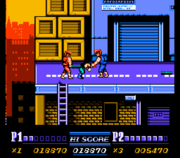
 Double Dragon II: The Revenge, this is a sequel title to a game which arrived earlier on the NES as an arcade port, something pretty standard back in the day of arcades, and like it’s original port, has variations from the arcade.
The trick is, the variations are much less than that of the original (which might as well been it’s own version of the arcade game but sucky). I was a huge fan of the original Double Dragon title in the arcade and was met with extreme disappointment when I found out it was strictly single player on the NES console.
This game was 300% better than the disappointing Double Dragon release on the NES. Granted, the NES version was fun to play, in single-player, but I purchased it for the two-player nature of the arcade version so I could play the game with my friends. Double Dragon II, on the NES had finally restored my faith in Technos Japan and the american publisher Acclaim. They took a bad situation and made it much better in the second release, why they didn’t make the original multiplayer is beyond me.
“All of the player’s techniques are available from the start and the two-player cooperative gameplay has been kept this time (with an alternative mode that has the friendly fire option turned on). Two new special techniques are added to the player’s repertoire in addition to the Whirlwind Kick; the Hyper Uppercut and the Flying Knee Kick. The NES version’s stage layout is composed of nine missions (including the final battle). While none of the stages are direct reproductions from the arcade game’s stages, they share many of the same elements, including background music. Many of these stages don’t have actual bosses, but traps which the player must avoid to clear the stage.” (wikipedia)
I understand why stages are modified for the home console release; after playing an arcade emulator of Double Dragon on my PC a year or so ago I was met with disappointment as I realized how short the stages and overall game is compared to any NES counterparts. The reason, to me, is simple: I had infinite quarters and when you have infinite money everything seems shorter than it really would be in “the wild.” However, in the arcade you want shorter games so you actually stand a chance of beating them without spending a thousand dollars and 10 hours at the helm.
The fact that they also give you all your abilities up front is nice, that’s how it was intended, why the original made you “learn” them with some stupid skill bar is beyond me, the game is a pure blood punch-and-fight arcade style title, not an RPG. If you wanted an RPG you’ve got to add more words, a plot that holds up and is well translated into English (for the most part) and has a varying degree of character development and roundness… in Double Dragon I just wanna beat things to the ground.
“Whereas in the original game, Marian was kidnapped, in the sequel she is shot to death by Black Warriors’ leader Willy right in the very beginning of the game, giving the game a much darker tone than the original. The plot deviates slightly in the NES version. While the revenge premise is the same, Willy does not appear in the game at all and a new final boss (the Mysterious Warrior) is introduced in his place.
The ending also differs between the original arcade version and in the NES version. In the arcade version, the game ends after Billy (and/or Jimmy) defeat their evil doppelgangers. The game shows a photograph of the Lee brothers and Marian. Marian sheds a tear that forms the words, “The End,” at the bottom of the screen. In the NES version, there’s an additional stage after the doppelgangers, where Billy and Jimmy must confront the Mysterious Warrior in a two-part final showdown. After they defeat the Mysterious Warrior, he tells the Lee brothers of the prophecy of his fighting style. Billy returns to Marian’s body to find her restored to life, as if she had merely been asleep.” (wikipedia)
Regardless to the weak plot, Double Dragon has always had a place in my heart, I’d love to see a re-creation on the Xbox 360, PS3 or Wii with “next generation” style, not another port or virtual game (save that for River City Ransom). I spent hours in the Pizza Shop as a kid playing Double Dragon, been kicked out a handful of times for being roudy, and had a plan o’l good time!
You can hear the full flashback in TD Gaming Podcast Episode 51.
Podcast: Play in new window | Download
