
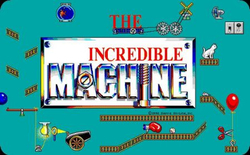
 The Incredible Machine (TiM) is a game designed and developed by Kevin Ryan and produced by Jeff Tunnel (now co-founder of GarageGames and their successful title Marble Blast Ultra on the 360 and co-founder in Dynamix makers of A-10 Tank Killer and The Red Baron). At the time, The Incredible Machine series came out of the shop known as Jeff Tunnel Productions.
Jeff Tunnel Productions published the first Incredible Machine games from 1993 to 1995 while Sierra Entertainment published all the rest of their titles all the way up to 2001. What is The Incredible Machines all about? It’s a game where you must build a series of Rube Goldberg devices in a “needlessly complex fashion” all to perform some simple tasks. That is the entire point to a Rube Goldberg device, which was originally defined as “accomplishing by extremely complex roundabout means what actually or seemingly could be done simply.”
I think everyone has seen a Rube Goldberg device, their are examples in science museums, and entire Myth Busters Episode about them, they appear in many movies (Goonies used one to open the fence to let in Chunk after he does his dance as did Doc Brown in Back to the Future to cook his breakfast and get his dog food).
The world has always been fascinated by the concept of the Rube Goldberg device, so making a game to accomplish the same tasks should be an obvious success.
Available objects ranged from simple ropes and pulleys to electrical generators, bowling balls and even cats and mice. The levels usually have some fixed objects that cannot be moved by the player, and so the only way to solve the puzzle is carefully arrange the given objects around the fixed items. There is also a “freeform” option that allows the user to “play” with all the objects with no set goal or to also build their own puzzles with goals for other players to attempt to solve. (wikipedia)
The first game in the series was supposed to be developed for EA and the Commodore 64 in 1984 but Dynamix was busy on Arctic Fox for the Amiga and didn’t get to it in time. The first title, named “The Incredible Machine” arrived 1992 with a taste of what was to come, a bunch of awesome levels of creation but it wasn’t until “The Even More Incredible Machines” which arrived later that year with twice as many levels and many more parts to use to build your Rube Goldberg devices–around 160 levels of crazy machines.
 After their first two releases there were some cartoon like spin-offs called Sid & Al’s Incredible Toons and another called The Incredible Toon Machine–both were not part of the series. In 1994 and 1995 we received The Incredible Machine 2 and The Incredible Machine 3 then in 2000 we got Return of the Incredible Machine and The Incredible Machine: Even More Contraptions in 2001. Their last two titles rehashed a lot of content with updated graphics, sounds and music but the last title had the ability to swap contraptions with other people online (although the service WonSwap is now defunct).
This game series, by far, is one of the best unique designs and creative thinking that I’ve seen in the industry. Although most titles are available on DOS or ran on pre-windows 95 (i.e. win 311) you can still find a few updates to make them playable on todays hardware. Although some critics say many titles after part-2 were re-hashes of the same features the original concept was innovative and a great seller, as a matter of fact Jeff Tunnel and Chris Cole (developer of the toon titles) earned a patent for their innovative game play concepts.
Unfortunately, today, it’s hard to find a fresh copy of TiM because Dynamix was closed by Sierra in 2001 and a bulk of Sierra’s was gutted by a financially flailing Vivendi Universal in 2004 (Vivendi, remember, is the parent company of Blizzard Entertainment or…Activision Blizzard if you will) and Sierra along with much of its development history was lost to new management, re-organizations and the like. You can indeed find TiM on GameTap if you belong to that services–it might just be worth it for this game alone. A release date of 2007 was announced for the original title to show up on Xbox Live Arcade… not sure where that has gone.
To hear all about The Incredible Machine, checkout the TD Gaming Podcast Episode 56!
Podcast: Play in new window | Download