
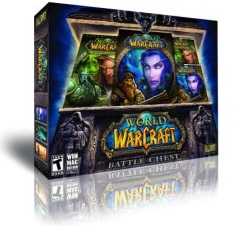
Imagine a Free World of Warcraft

Once upon a time the folks at Blizzard Entertainment thought they could support the entire world of World of Wacraft by ad revenue. This would have created an MMO experience which would cost you nothing but a bit of annoyance by ad providers; what would the total audience be if the game was free?

Had WoW launched free of charge they would probably have significantly more users playing the game, but the ad revenue from the sheer amount of people would be nothing compared to a monthly charge for eight million subscribers.

Although only a small number of those subscribers are US based, they’re still raking in the cash compared to an ad-based model, even if they were to have triple the subscribers.

However, the Blizzard exec noted: “We didn’t want to charge a subscription, but as we researched market conditions, we realized that wouldn’t support us.”

It’s possible, perhaps, that Blizzard would have fallen under its own weight had they created a world where anyone could play for no charge. Imagine the server utilization, the volume of traffic and the support calls they would get for triple or quadrupal the player base with only ads paying the checks.

Granted, a free system would be excellent in theory, but in practice, making us pay is the only way to throttle our addictions. Sad, but true.

(Thanks, gamasutra)

Leave a Reply

Your email address will not be published. Required fields are marked *

Related Post

Xbox 360, PS3 and Wii: Who’s Winning And HowXbox 360, PS3 and Wii: Who’s Winning And How

People see facts and figures constantly and brush them off as, well, facts and figures. But, when people see charts and graphs they “oooh” and “aaaah” over them because the visualization is easy to understand. Now, thanks to the NPD Group and Deutsche Bank, people are seeing some pretty graphs about the console battle. These show just how well the race is going on all fronts of the war.

Hardware Sales chart, via gamedaily.com

Although the data is fairly small the colors show it all, the Wii crossed over the Xbox 360 numbers in unit sales and hasn’t stopped since the launch. Here we are, on the third holiday season since the Wii launch, and people still cannot find them in stores. Shortage? Doubtful. Considering the massive sales numbers and the fact that they did take the 360 in numbers it seems the supply just can’t meet the over-the-top demands, but why is the demand so high for the little Nintendo bundle of joy? People just can’t get enough Wii.

The Xbox 360 has much to brag about as well, they’re not first in the race but their nearest next-generation graphic console, the PlayStation 3, isn’t even close. The chart shows them both rising in much the same way, with the same “pops” along the sales chart but in a completely different scale. Since Microsoft doesn’t want to consider Wii a competitor, they’re clearly winning the war in their eyes.

Oddly enough, one of the big pops in Xbox 360 sales where around the PS3 launch. Perhaps these consumers were waiting for both consoles to launch before making a decision? More than likely, it was holiday related and had little to do with the PS3 launch but it is fun to ponder anyway.

What about software sales? We’ve heard the Wii has little to offer in terms of games while the 360 wipes the floor with the competition.

Software sales charts, via GameDaily.com

To our surprise, the Wii is rocking the sales figures in terms of software but still doesn’t compare to the Xbox 360. Microsoft pulls out 93-million units while Nintendo takes home a modest 73-million units in software… yet again Sony doesn’t show up to the fight. Looking at November 2007, you can see the Wii jumps significantly in unit sales, no doubt related to the Super Mario Galaxy launch — once they hit that figure they never looked back and continued to climb.

Although a few of us expected Sony’s PlayStation 3 to make huge progress this year, each month they have marginal growth is causing their competitors to excel beyond anyones imagination. We’re starting to wonder how well Sony’s “10 year plan” is going to work out with their competitors taking advantage of the market now when, in 10-years, they will be sitting on their pile of cash to re-invest in the 8th generation of consoles.

(Thanks, GameDaily)

Episode 276: Covered in ConcreteEpisode 276: Covered in Concrete

Paul is not in the podcast, and will be out for the next couple of weeks as he recovers from major surgery. In the meantime, the podcast chugs on with three podcasters, as Jordan relays what he thought of the Sony Gamescom 2012 press conference.

In the meantime, the news items include:

All that plus Reader Feedback wishing Paul well (sorry, Kizer, we didn’t moderate your message til after recording), as well as this week’s Question of the Week, “When is the right time to cut the price of a console?”

DSi Will Be Region-Locked, Sad Face…DSi Will Be Region-Locked, Sad Face…

One of the greatest things Nintendo has done was allowing the DS to be unlocked for regions. This allowed gamers around the world to share their favorite games from all cultures and countries with just a click of the “buy” button at an online store.

The DSi loses this great freedom by locking it down to a region. “Nintendo DS software is region free so you can play any DS software on DSi from any region. You can also browse the internet on your DSi wherever you are in the world and exchange your photos with friends from around the world,” says Nintendo (CVG).

Much like the US Entertainment Industries need to lock down everything and contribute to global piracy, Nintendo follows suit with their hand-helds, tis a sad day indeed. Of course Nintendo reasons it all away by yelling parental controls and making it easier for regions to access their own content.

“DSi is region locked because DSi embeds net communication functionality within itself and we are intending to provide net services specifically tailored for each region. Also because we are including parental control functionality for Nintendo DSi and each region has its unique age limit.”

Specifically tailored for each region is a nice way of saying that each region has to pay the penalty of not being “first” (second, or third) to get some cool new features. Although Nintendo could put emphasis on the region the gamer lives in with complete access out of those bounds if they wanted, they’ve chosen to use this as a crutch to lock users out of content.

Users will get their content, of course. It just means more home brews, software hacks, hardware hacks and workarounds for the system. If that’s what Nintendo is trying to inspire, then they’ve done their job right.

However, wouldn’t it be great if they could just come out and say “we don’t want certain people accessing specific content until we say you can.”