
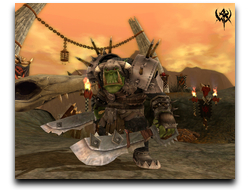
A few months ago, Activision Blizzard CEO Bobby Kotick said investing $500 million to a billion still wouldn’t be enough to compete with an MMORPG like World of Warcraft. The MMORPG space is a costly investment and you’d need to really burn a lot of money to start competing against the mega-giant, but Mythic VP and Warhammer Online lead designer Mark Jacobs disagrees with that quote.
Jacobs says $100-million dollars would be needed to start competing against the giant subscription generator that is World of Warcraft. Although few developers are sitting on $100-million USD, it’s a bit more realistic an investment for a studio to scrape up compared to a billion bucks! A billion dollars is a scary number when you consider that’s the start of an investment that may, or may not, pay off in the end.
Kotick may not be using complete scare tactics, he may be working off experience when dealing with MMORPG’s. A startup MMO isn’t a cookie cutter system, there is a lot of development efforts, $100-million dollars worth, but MMO developers slip dates many times. When you start slipping your dates you’ll start burning more money and, before you know it, you’re a billion in the hole. Jacobs thinks $100-million will cover development costs and messing up, so a billion is still way over budget.
Perhaps this is a bit of a scare tactic, assuming a developer will fail and slip their dates isn’t really a great way to start quoting prices. However, shooting too low isn’t always the best method of building your development assessments. The end result, scream ONE BILLION and you may scare off any potential startup MMO developers.
Warhammer Online lead designer did mention one big barrier to entry: the need for “at least half a million subscribers to be successful.”
Well, we hinted at it in the last few podcasts, and now it is live: TD Gaming Podcast is now looking for listener support through Kickstarter.
It’s very easy to donate: just visit our Kickstarter page and click that donate button. The goal is pretty modest, a mere $1500. If all our listeners each donated even just $5, we’d blow by that amount.
What will we do with the money? Make sure we can keep old episodes without having to delete them due to limited server space, and get pro mics for every podcaster. The more money, the longer we can go without worrying about server subscriptions.
We have a few fun reward tiers – our most hardcore fans will definitely want an MP3 of one of the crew or any of the crew recording a voice mail or answer machine outgoing message, or the entire podcast bantering for a few moments. There’s also the requisite T-shirt, which will have the awesome Gaming Podcast logo.
And if you’re in the NYC area, or plan to be, Jonah Falcon will have dinner at a nice restaurant with you. If you’re going to plop that much dough down, how could we refuse a free dinner?
Keep the TD Gaming Podcast alive – donate. We’re counting on you.
In this long episode of Gaming Podcast, the show runs long because of the tons of entries made to win a Steam code of XCOM: Enemy Unknown. Paul gets upset at Jonah for a topic about the Wii U, while Dan is delighted to say the F-word again. The latest Gaming Flashback is about the oldest coin-op arcade game from 1971, Galaxy Game.
The news includes the following items:
Sony drops 3D support, saying customers rejected it
This article was published on January 19th, 2009 by me, about an MMO that never came to be.
With Ultima Online heading into its 12th year, and Richard Garriott declaring he wants to make a new fantasy MMORPG, its time to examine the MMO that never was: Ultima X: Odyssey.
Before any discussion of Ultima X can be made, one must examine Ultima IX: Ascension, a 1999 disaster that basically doomed the Ultima franchise, and ultimately, Origin Systems, Garriott’s development company that was purchased by Electronic Arts in 1992. Ultima IX was an ambitious, completely 3D game that promised to be revolutionary. For instance, when you shot an enemy with an arrow, the arrow would persistantly remain in the enemy; it didn’t help that enemies could withstand a ton of damage, so they often resembled chia pets with dozens of arrows sticking out of them. The attempt came at a price, however. The graphics engine was so demanding, large cities were villages. There were numerous bugs and glitches. Worse yet, the game was so divorced from the previous Ultima titles in terms of story and characterization that devoted fans were annoyed and turned off from it.
Ultima Online was released in 1997, and when it began to be overshadowed by graphically superior games that utilized 3D engines like Everquest, they began develop of a 3D Ultima MMO called Ultima Worlds Online: Origin. Aside from the new engine, UWOO promised to have parties of 20-30, presaging the online raids that World of Warcraft would perfect. However, the sequel to Ultima Online was doomed by its predecessor – Electronic Arts feared UWOO would steal subscribers from the still profitable UO and canned the development group, sending Garriott packing. Sony, on the other hand, had no such qualms about a sequel and released Everquest 2 in 2004, which was successful in eventually transitioning fans from the first to the second game.
By the time 2003 rolled around, an host of new 3D MMOs had been released, including Dark Age of Camelot in 2001, and Ultima Online‘s subscribership was dwindling quickly. It was clear Ultima Online was now a dinosaur in the MMO world, and it needed to be updated. At E3 2003, Electronic Arts announced their second attempt at an MMO, Ultima X: Odyssey. The reaction to it was immediately positive, as you can tell from the above video.
One of the deliberate challenges by the designers of the announced MMO was the name itself. Unlike Ultima Online and the aborted Ultima Online Worlds: Origin, Ultima X was putting itself in the canon of the series as a numbered Ultima; when rumors of Ultima X began, people initially thought it was to be the first of a new trilogy. The use of the “X” was seen as a bold declaration in another way: it was following the disastrous Ultima IX, putting the game in the same position that Star Trek VI did, having to follow the footsteps of a franchise-killer. Furthermore, this was being done without Garriott, the lifeblood of the Ultima franchise, for the first time.
In being the “next Ultima RPG”, the developers stressed that it would be more like Ultima than Ultima Online was. Lead designer Jonathan Hanna explained in an interview at E3:
UXO is also more heavily based on the previous Ultima single-player games than UO is or Origin (UWOO) was going to be. The Ultima RPG series is considered by many to be one of the best RPG series ever. Ultima 4: Quest of the Avatar™ and Ultima 7: The Black Gate™ are often listed in best games of all time lists in gaming polls. It is no accident that the franchise has continued for over 20 years now. UXO will hearken back to the legendary world first brought to life in those classic games as well as creating new twists that will appeal to both old time fans and those who have never played an Ultima game. (GameZone)
Even more appealing was the way characters would develop. The player would pick from six races – elf, orc, pixie, phoda, gargoyle and human – and use one of four Paths, each of which would allow players to buy skills from four different subclasses – a system later adopted by Tabula Rasa.
For example, the Path of the Blade includes Fighters, Knights, and Barbarians. Players who choose the Path of the Blade can select abilities (skills) from any of these Disciplines. In most class-based games you have to choose either a Fighter (a primary class) or a Barbarian (a hybrid class). UXO’s character advancement allows you to either focus on one Discipline or create your own hybrid class.
Player characters would further be affected by the eight Virtues that were found in every Ultima game since IV. Every mission would increase a player’s rating in one of eight Virtue, and gaining in Virtues would allow you to buy Virtue-specific equipment. Even more off the beaten path, a player would create additional characters, and if each of their PCs achieved the maximum in a Virtue, the original PC would become an Avatar.
Another interesting aspect in trying to create a more player-centric experience was that rather than players seeking out missions, the missions would come to the player.
The people of Alucinor will need your help and they aren’t shy about asking for it. Once you accept a quest, you’ll have the opportunity to make choices that will change the direction of the quest, the reactions of the NPCs and monsters, and the reward you get. So you don’t have to follow a predetermined story in order to succeed; you can actually role-play the various situations and create your own unique adventure. The choices you get to make are based on the Ultima Virtues, so there are no wrong choices. Just decide how your character would react.
So, the gamers who tried it out at E3 2003 loved it, and the developers had unique MMO experiences prepared, and a proven MMO license backing it. What went wrong?
On June 30, 2004, the following message appeared on the UXO website:
This isn’t an easy decision, but it’s the right move for the future of all things Ultima, including the community and the team. We look forward to sharing our plans for the future of Ultima Online very soon.
I would like to thank all of the Ultima X: Odyssey supporters who have been with us from the beginning. I hope you will continue to support the Ultima franchise and the development team as they transition to new projects.
Once again, Electronic Arts balked at starting a new Ultima MMO and chose to support the aged Ultima Online with new expansions. But why?
The chief reason was the sheer glut of MMOs being developed and released at the time – Ultima X: Odyssey would have to compete against fellow E3 2003 showcases World of Warcraft, Everquest II and City of Heroes. At the time, EA balked at losing their older property with a chancy new product that had different gameplay from its predecessor. An odd decision, as mentioned earlier, since Sony had no compunctions about replacing Everquest with a sequel – with more demanding graphics.
One must wonder what the MMO landscape might have been had UXO been released to compete with World of Warcraft and the other MMOs. What do you think?
0 thoughts on “Activision Blizzard Trying To Scare Off Competition?”