Rhythm Gaming is all the rage, or is it? Turns out Guitar Hero: World Tour didn’t meet or exceed the figures they hit with Guitar Hero III. Where GH3 brought in $115 million in the first week, GHWT brought in $67 million in the same time frame.
Why?
There are plenty of factors that could cut down the sales units, considering those that can purchase Guitar Hero World Tour don’t have to purchase additional instruments to play the game like they played GH3.
- Rock Band 2: This game arrived before Guitar Hero 3 and folks went for this game instead because it was first to launch. Some gamers have to make a choice on which to purchase because they can’t buy both.
- Hot Games: Although Rhythm gaming can be fun, a lot of great games are arriving this season so gamers have to make some big decisions.
- Economics: The economy isn’t exactly thriving right now and retail outlets are already predicting less than stellar numbers.
- Saturation: Since the original Guitar Hero game, we’ve had a number of titles from Activision including their Aerosmith edition and Harmonix pulling out Rock Band and Rock Band 2. There is talk of a Hendrix version and a Metallic release – how much is too much?
We know people love charts, so here is another to toss at you via Kotaku:
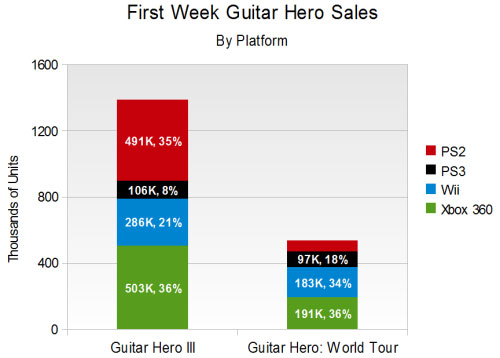
Guitar Hero World Tour Sales, via Kotaku
The break down from Guitar Hero 3 to World Tour is obvious, also apparent is the shift in console when buying into the rhythm gaming franchises. The Wii has started taking more market share, odd considering the DLC isn’t there, and the PS3 is showing its lackluster sales of the console by growing in proportion but not excelling to grab huge share (PS3 fanboys attack!). Sony kicked ass by taking control of the share using their PlayStation 2 with Guitar Hero 3, but has lost that lead for the World Tour.
Will these lower sales figure change the future roadmap for Activision in their Guitar Hero franchise or are they satisfied taking home $67 million in the first week of the launch. That is still a lot of money and probably doesn’t even consider any money they could (or will) potentially make on the World Tour hardware.
Luckily, the rhythm gaming content doesn’t get old with age, it just gets more classic. No doubt Guitar Hero World Tour will be landing in homes over the holidays and into 2009.
 It’s clear publishers like Electronic Arts hate to take risks on video games. They’re not alone in their opinion, look how many sequels we’ve got for the holidays compared to new creative titles like Little Big Planet, or how publishers push out sequels to hot titles until we can’t take it anymore; how many Guitar Hero titles will arrive before we scream “enough!”?
 Looking for a place to leave podcast feedback and you don’t feel like firing off an e-mail? You can now