
Some of the worst voice acting in videogame history can be bearable, when someone decides to supply a face for them.
Check out YouTube user HansJamesMusicAOk’s hilarious “face acting” on the sound clips from 50 of the worst voice acting in games.
Some of the worst voice acting in videogame history can be bearable, when someone decides to supply a face for them.
Check out YouTube user HansJamesMusicAOk’s hilarious “face acting” on the sound clips from 50 of the worst voice acting in games.
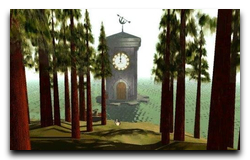 Myst was published by Brøderbund Software, developed by Cyan Worlds and created by two brothers that did the design and directed the game (it was, much like a movie).
The original game was released on the Macintosh (in 1993) and then later ported to Microsoft Windows and Sega Saturn, PlayStation, Jaguar CD, AmigaOS, CD-i, 3DO, PlayStation Portable, and Nintendo DS.
“Myst puts the player in the role of the Stranger, who uses an enchanted book to travel to the island of Myst. There, the player uses other special books written by an artisan and explorer named Atrus to travel to several worlds known as “Ages”. Clues found in each of these Ages help reveal the back-story of the game’s characters. The game has several endings, depending on the course of action the player takes.” (wikipedia)
The game was a success, no doubt, and was considered the best selling PC game of all time until TheSims dethroned it. Besides mind blowing graphics, at the time, Myst helped move the game and PC industry along by selling CDROM’s. The game required a CDROM, which was rare at the time, and I recall them bundling Myst with some CDROMS or hyping it as “you need a CDROM so you can play Myst.” On more than one occasion when a person game to me asking what they should get to show off their new (costly) CDROM I would say “you need to try Myst.”
The gameplay of Myst consists of a first-person journey through an interactive world. The player moves the character by clicking on locations shown in the main display; the scene then crossfades into another frame, and the player can continue to explore. Players can interact with specific objects on some screens by clicking or dragging them(wikipedia)
Franchise sales: 12-million copies (first Myst game alone in the franchise, 6-million), pretty impressive eh?
You don’t have to be a huge Myst fan to know how it changed the industry, grew the medium of CD-based games and entertained millions. A real gamers thinking game!
To hear our full impression of Myst, checkout the TD Gaming Podcast Episode 77.
Podcast: Play in new window | Download
Gaming Podcast’s Jonah Falcon and Shack News’ T.J. Denzer do a totally-not-ripping-off-Zero-Punctuation’s-Let’s-Drown-Out video of the former playing Prince of Persia 2008 as they discuss some of the news of the day.
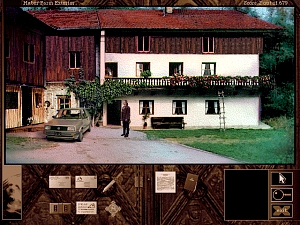 One of the great downfalls of an acquisition or merger, in the game industry, is the loss of great franchise titles. Sierra, or Sierra Online, once stood on its own as a company with great gaming titles but later fell into the depths of Hades under many different company names.
Sierra’s last stop on the acquisition highway was Vivendi, years after much of Sierra’s steam had slowed. Now, they’re part of Activision Blizzard so we had high hopes they’d find a great use for some of the old Sierra properties long since collecting dust. Space Quest, Kings Quest, Leisure Suit Larry and especially Gabrielle Knight were some of our favorites, but times have changed.
“We are retaining only those franchises that are a strong fit with our long-term strategy including Crash Bandicoot, Ice Age and Spyro, as well as Prototype and a second game that has not yet been announced. We will not publish any other titles that previously were part of the Vivendi Games portfolio and we are currently reviewing our options regarding those titles,” says Activision Blizzard (joystiq)
This is unfortunate news, Activision Blizzard now has a large set of franchises on their hands, many of which have collected dust for years. Those dust collecting franchises could rise from the dead and reinvigorate their old fan base… or be dropped to the earth as unwanted scrapes after a big hunt with the vultures awaiting their take (sorry, too much watching of Animal Planet)
A reworked Kings Quest or Gabriel Knight could have seriously awesome potential in this time and age, imagine a dark comedy version of Gabriel Knight or a huge scaled world in King Quest using todays graphic engines. Although, these titles could also go the way Atari has gone and taken a well remembered franchise and made mud of its great name (*cough* Alone in the Dark).
Unfortunately, we’ll probably never know the distance an old franchise could go in this new world. We’ll have to pull out an old copy of our prized posessions and remember just how great they once where.
:)) ah man, I did the mistake to watch this at work 🙂
Thanks for the find!