
Gaming Flashback: SimCity

SimCity was released in 1989, was originally called Micropolis and was designed by the infamous Will Wright. For those that don’t know Will Wright, its suffice to say he’s one of the most popular and influential game designers of our time. SimCity, TheSims, SimAnt, SimFarm and Spore are a few of his hits and TheSims has taken many records since its original release.

Wright had trouble finding a publisher for a game in which you couldn’t really “win or lose.”  Turned down by Broderbund, Wright eventually pitched the idea to Jeff Braun of Maxis.  Maxis agreed to publish Simcity as one of its first two games.

When near complete, Wright and Braun took the game back to Broderbund to clear the rights for the game.  Broderbund executives Gary Carlston and Don Daglow saw how addicting the game could be and signed Maxis to a distribution deal.  Four years after initial development, SimCity was released for the Amiga and Macintosh platforms, followed soon after by the IBM PC and Commodore 64.  On January 10th 2008, the SimCity source code was released under the GPL license as… Micropolis!

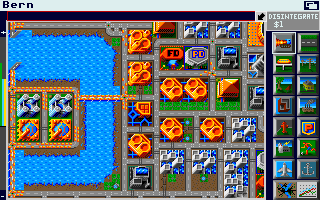
The objective of the game is simple, build and design a city.  Though the player could focus on building a highly efficient city with an ever growing populace, it was by no means required.  In a sense, open ended, the player was free to design the city as they chose.

Included in the city building experience was the possibility of natural disasters such as flooding, tornadoes and more.  Pre-designed scenarios were also included in the game such as the Boston 2010 nuclear meltdown, or mass coastal flooding of Rio de Janeiro of 2047 … even a Godzilla attack of Tokyo in 1961.

In the years to follow, the SimCity franchise would continue to expand with greater detail as SimCity 2000 (1993), SimCity 3000 (1999), SimCity 4 (2003) and a host of other “Sim” games and until the release of “The Sims” in 2000, the SimCity series was the best-selling line of games made by Maxis.

In Fall of 2008, EA will release the next child in the SimCity family, SimCity Creator for the Nintendo Wii and DS systems. And thus, history continues!

Leave a Reply

Your email address will not be published. Required fields are marked *

Related Post

Guitar Hero: Aerosmith Hit’s the ShelvesGuitar Hero: Aerosmith Hit’s the Shelves

Guitar Hero: Aerosmith is out, gamers rejoyce. Reviews show the game being “so so” in terms of value and total experiences. GameSpot gave it a 7.0 out of 10 saying it’s a bit short, 41 songs instead of the typical 70+ from other Guitar Hero games… but you’re still paying full price.

They’re also saying Guitar Hero: Aerosmith is easier, which is great for the non-hardcore players. For those uberskills shown off in so many youtube video’s, you’ll probably wanna stick to Guitar Hero III. IGN ranked it a 7.6 out of 10, with much of the same issues as other review sites have found: lots of “the same” in this title only with Aerosmith songs instead of a variety, a bit easy and only attractive to those that like Aerosmith.

If you’re a huge Aerosmith fan, this game goes without saying. If you’re looking for additional guitar tracks to rock out on, again, not a bad selection. If you’re looking for the next great rock and role gaming experience, this isn’t worth the cash it seems.

(more…)

Episode 253: Future GenerationEpisode 253: Future Generation

This week, Paul is still not available, which is unfortunate, since the Gaming Flashback is the classic DuckTales for the NES. There’s also a bunch of scintillating news items including:

  • Pachter: Nintendo “Blew It” With Wii U, “In Disarray”
  • Bethesda hiring talent for Xbox 720, PlayStation 4 game
  • EA reveals Mass Effect 3 preorders well ahead of Mass Effect 2‘s
  • Pachter: Next generation Sony and Microsoft consoles will have 4GB SKU
  • Sony filed patent For Kinect-like motion device
  • PSN Minis not working on Vita

We also reveal the winner of the Pixie Diamonds contest.

Gaming FlashBack: Baldur’s GateGaming FlashBack: Baldur’s Gate

Baldur’s Gate isn’t too old, it was released in November of 1998, but that’s still a bit dated now. The gaming industry isn’t friendly to the years, often working in what seems to be accelerated “dog years” in terms of technological advancements. It figured this was worth covering because it’s one of the best selling and considered a top tier single-player RPG by most accounts.

It was also developed by BioWare, who, at the time, only had one other game under their belt from two years before called Shattered Steel.

The story begins just after a devastating event in the Forgotten Realms D&D campaign called the “Time of Troubles.” This was a great twist in the standard D&D campaign, it caused all curative magic (clerics) to lose their ability to heal unless near their deity, magic didn’t function correctly (I believe this is where the Wild Mage came from) and was unpredictable and gods walked the earth as mortals which caused magic to, in effect, die while the gods were away. Since the storyline starts slightly after this event, the game contains healing and magic but the storyline is impacted by prior events of course, people have trust issues.

The game was made great because it held “mostly true” to the 2nd Edition D&D roots so the learning curve for D&D player’s wasn’t so rough; some things were adjusted to handle the real-time effect of a video game RPG. You could party with up to six Non-Player-Characters (NPC’s) whom would swap in and out of your active party over time as part of the storyline (something also implemented by the US release of Final Fantasy 2).

(more…)