
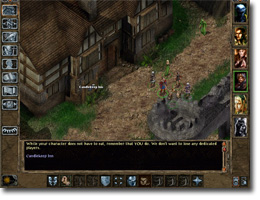
 Baldur’s Gate isn’t too old, it was released in November of 1998, but that’s still a bit dated now. The gaming industry isn’t friendly to the years, often working in what seems to be accelerated “dog years” in terms of technological advancements. It figured this was worth covering because it’s one of the best selling and considered a top tier single-player RPG by most accounts.
It was also developed by BioWare, who, at the time, only had one other game under their belt from two years before called Shattered Steel.
The story begins just after a devastating event in the Forgotten Realms D&D campaign called the “Time of Troubles.” This was a great twist in the standard D&D campaign, it caused all curative magic (clerics) to lose their ability to heal unless near their deity, magic didn’t function correctly (I believe this is where the Wild Mage came from) and was unpredictable and gods walked the earth as mortals which caused magic to, in effect, die while the gods were away. Since the storyline starts slightly after this event, the game contains healing and magic but the storyline is impacted by prior events of course, people have trust issues.
The game was made great because it held “mostly true” to the 2nd Edition D&D roots so the learning curve for D&D player’s wasn’t so rough; some things were adjusted to handle the real-time effect of a video game RPG. You could party with up to six Non-Player-Characters (NPC’s) whom would swap in and out of your active party over time as part of the storyline (something also implemented by the US release of Final Fantasy 2).
They start you out in a town, and you kill rats and small rodents to learn the basics of the game, all while playing the role of your newbie character. You then ride out of Candlekeep with Gorion, your teacher who is killed in the night by some shady people, you get away and meet up with your best friend, the ever annoying Imoen, who was also teaching under said master and insists on coming with you.
The story weaved well, written like a true Forgotten Realms novel, the game implemented the AD&D rules well, and the RPG genre was flailing at the time; we had Fallout and Diablo but nothing really D&D like, this helped bring back that genre and Bioware was able to build a number of expansions for the game and use the game engine to spin-off other titles like Planescape Torment and Icewind Dale, although they didn’t have a direct hand in all the spin-offs their core engine was responsible for much of it.
It wasn’t without critics, AD&D fans would complain about not being 100% faithful (they don’t understand game design), some folks were upset at the poor path finding ability (patched a few times later) and the graphics and map were awesome for the time but were restricted to 640×480, which fans later “fixed” in their own cooked up mod’s.
All in all, this was a solid RPG experience with a great core game engine helping build up a falling RPG industry. Perhaps Bioware was the inspiration for some of the future RPG’s in terms of creativity, faithfulness to the Dungeons and Dragons realms and its fairly well crafted dialog tree.
To hear all we have to say about Baldur’s Gate, checkout the TD Gaming Podcast Episode 76.
Podcast: Play in new window | Download