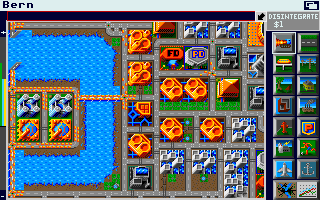
 SimCity was released in 1989, was originally called Micropolis and was designed by the infamous Will Wright. For those that don’t know Will Wright, its suffice to say he’s one of the most popular and influential game designers of our time. SimCity, TheSims, SimAnt, SimFarm and Spore are a few of his hits and TheSims has taken many records since its original release.
Wright had trouble finding a publisher for a game in which you couldn’t really “win or lose.” Turned down by Broderbund, Wright eventually pitched the idea to Jeff Braun of Maxis. Maxis agreed to publish Simcity as one of its first two games.
When near complete, Wright and Braun took the game back to Broderbund to clear the rights for the game. Broderbund executives Gary Carlston and Don Daglow saw how addicting the game could be and signed Maxis to a distribution deal. Four years after initial development, SimCity was released for the Amiga and Macintosh platforms, followed soon after by the IBM PC and Commodore 64. On January 10th 2008, the SimCity source code was released under the GPL license as… Micropolis!
The objective of the game is simple, build and design a city. Though the player could focus on building a highly efficient city with an ever growing populace, it was by no means required. In a sense, open ended, the player was free to design the city as they chose.
Included in the city building experience was the possibility of natural disasters such as flooding, tornadoes and more. Pre-designed scenarios were also included in the game such as the Boston 2010 nuclear meltdown, or mass coastal flooding of Rio de Janeiro of 2047 … even a Godzilla attack of Tokyo in 1961.
In the years to follow, the SimCity franchise would continue to expand with greater detail as SimCity 2000 (1993), SimCity 3000 (1999), SimCity 4 (2003) and a host of other “Sim” games and until the release of “The Sims” in 2000, the SimCity series was the best-selling line of games made by Maxis.
In Fall of 2008, EA will release the next child in the SimCity family, SimCity Creator for the Nintendo Wii and DS systems. And thus, history continues!

@GameStop vs. Deus Ex
Paul, Deus Ex are two separate words.
As for the news item itself, well, we talked already in the forums. Just one thing I want to say: they should have pulled the game from the shelves right at the beginning, instead of taking out the coupon.
That’s tampering with a product, so I agree with Paul.
@Origin EULA:
Jonah pointed it clearly, the new formulation says absolutely nothing of what they will or will not do.
If this is not an excuse for pirates, then I don’t know what is …
Paul, the question is, once you have the power to access a lot of customer information, what will enforce a corporation to only do “the good thing”?
Yes Jordan, you can call me Mr. Alien.
And Jonah, the reason my sister liked UT is because of the flak cannon: she loved shredding enemies to pieces with it.
@Are you interested in Epic Mickey 2?
No. Sorry, just can’t see myself jumping from STALKER/Doom 3 and the likes to Epic Mickey 1, 2, 3 or 999.
Paul, Jonah doesn’t dismiss your opinions. He dismisses any opinion that doesn’t fit with his. So yeah, he’s a bit of a bully.
Still, while he doesn’t agree with some of the stuff that I write, he still gives voice to my comments (although now it seems to be Jordan).
Jordan was right, this kind of conflicts do give the show some charm.
@ Flop vs. Failure:
The two terms are interchangeable when it comes to the subject at hand. Heck, one of Miriam-Websters’ definitions of flop is “To fail completely.”
@ Who has one console?
If you count current-gen consoles, I only have one. If not, then I still only have two, the other being a PS2. The Wii never managed to grab my interest outside of its initial scavenger hunt craze to find one. (Which I didn’t.) The PS3 was out of my price range long enough for me to skip over it, and the bulk of the people I play with are either mainly or only 360 owners, as well.
@ Episode 227’s Question:
I used to dream of DDR, and still see stepcharts in my head while listening to music daily. Now that I’ve been watching some MLG videos, I’m dreaming about being there and wondering what the heck I’m doing.
@ Epic Mickey 2:
Possibly, as the first seemed to have interesting concepts, but I never got to play it, as I don’t own a Wii. I would think about picking up a sequel if it comes out for the platform I own.
(And, yes, I know that askewed isn’t a proper conjugation of the word, that’s kind of the point.)
Is this where I send my hate mail for VGRT?
haha.
not sure what that was about…
Paul sounded like he was PMS-ing pretty bad…
get that guy a Midol! stat!
funny show, with lots of good info, and, though
I hate to admit it, the arguing makes it even more entertaining…
He’s like your Bababooey or something.
anyway, thanks for the info & laughs!