
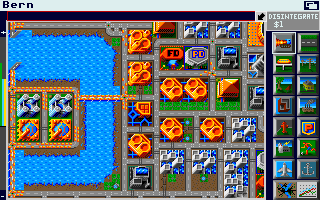
Gaming Flashback: SimCity

SimCity was released in 1989, was originally called Micropolis and was designed by the infamous Will Wright. For those that don’t know Will Wright, its suffice to say he’s one of the most popular and influential game designers of our time. SimCity, TheSims, SimAnt, SimFarm and Spore are a few of his hits and TheSims has taken many records since its original release.

Wright had trouble finding a publisher for a game in which you couldn’t really “win or lose.”  Turned down by Broderbund, Wright eventually pitched the idea to Jeff Braun of Maxis.  Maxis agreed to publish Simcity as one of its first two games.

When near complete, Wright and Braun took the game back to Broderbund to clear the rights for the game.  Broderbund executives Gary Carlston and Don Daglow saw how addicting the game could be and signed Maxis to a distribution deal.  Four years after initial development, SimCity was released for the Amiga and Macintosh platforms, followed soon after by the IBM PC and Commodore 64.  On January 10th 2008, the SimCity source code was released under the GPL license as… Micropolis!

The objective of the game is simple, build and design a city.  Though the player could focus on building a highly efficient city with an ever growing populace, it was by no means required.  In a sense, open ended, the player was free to design the city as they chose.

Included in the city building experience was the possibility of natural disasters such as flooding, tornadoes and more.  Pre-designed scenarios were also included in the game such as the Boston 2010 nuclear meltdown, or mass coastal flooding of Rio de Janeiro of 2047 … even a Godzilla attack of Tokyo in 1961.

In the years to follow, the SimCity franchise would continue to expand with greater detail as SimCity 2000 (1993), SimCity 3000 (1999), SimCity 4 (2003) and a host of other “Sim” games and until the release of “The Sims” in 2000, the SimCity series was the best-selling line of games made by Maxis.

In Fall of 2008, EA will release the next child in the SimCity family, SimCity Creator for the Nintendo Wii and DS systems. And thus, history continues!

Leave a Reply

Your email address will not be published. Required fields are marked *

Related Post

Gaming Podcast 134: Do You Want Me To Feel It?Gaming Podcast 134: Do You Want Me To Feel It?

This weeks gaming flashback? Scorched Earth, a great artillery style title. We’re also taking a historic look back at the game innovations developed by Don Daglow. Of course it’s not a full news week without some actual news! This weeks news includes:

  • podcast-200x200Walmart Pushing New Madden Game
  • Bestbuy takes on Gamestop
  • Halo 2 and Halo 3: ODST possibly coming to Games on Demand
  • Nintendo not happy with E3 briefing
  • Nintendo Even baffled by Vitality Sensor
  • WoW Rumor: Two new playable classes in next expansion

This weeks community feedback was epically cool, we’re continuing the questions this week by asking: What game would you invent using the Wii balance board and vitality sensor? Do you have some ideas to solve Nintendo’s problem?

Episode 284: Joining KickstarterEpisode 284: Joining Kickstarter

The TD Gaming Podcast has started its Kickstarter fundraising, and really, even if every listener donated a few dollars, the project will get funded.

This episode is a bit short thanks to Dan having to skip this week and Jordan and Paul’s busy schedules. Don’t worry, this is only a one time thing, and a full length podcast will be recorded next week.

In any case, this week’s news includes:

  • Avellone: Kickstarter still in its infancy
  • PAX Australia tix now on sale
  • CD Projekt RED’s new licensed sci-fi RPG officially titled Cyberpunk 2077

This week’s Question of the Week, “What is your favorite convention to attend?”

Gaming Flashback: Lode RunnerGaming Flashback: Lode Runner

Lode Runner, a game many of us logged hundreds of hours upon. Lode Runner has a great deal of replay value thanks to its great map editor. The game was first published by Broderbund in 1983, but was first prototyped by Douglas Smith, an architecture student at the University of Washington.

The Lode Runner prototype was called Kong and was originally written for a Prime Computer 550 minicomputer on campus, but shortly after it was ported to the VAX minicomputer. Originally programmed in FORTRAN and utilized only ASCII character graphics (the most basic of characters).

In September of 1982 Smith was able to port it to the Apple II+ (in assembly language) and renamed it to Miner. In October of that same year he submitted a rough copy to Broderbund and he’s said to have received a one-line rejection letter, “Sorry, your game doesn’t fit into our product line; please feel free to submit future products.”

The original title had no joystick support and was developed in full black and white…not exactly exciting. So, Smith then borrowed money to purchase a color monitor and joystick and continued to improve the game. Around Christmas of 1982, he submitted the game, now renamed Lode Runner, to four publishers and quickly received offers from all four: Sierra, Sirius, Synergistic, and Brøderbund.

(more…)