
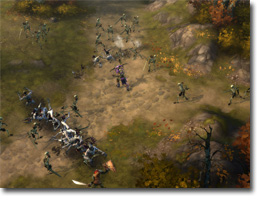
Diablo 3: How Many Headlines Can It Catch?

Imagine we told you the story of a game where you hack things up over and over and over and over by clicking the mouse to gain items. These items allow you to go into harder areas of a dungeon and hack things up over and over again. Would you buy into it? Probably not.

Yet Diablo, since its inception, has fascinated gamers with the fundamental goals of hacking and slashing your way to a hellish beast in hopes to hack and slash him as well. It does, however, have a firm storyline which has gotten better with age and usually marvels gamers with graphic advancements set to blow the mind.

Diablo II had some nice graphics, but they were not mind blowing and earth shattering but the game continued to be fun to play. So fun, some gamers continue to play Diablo II even today, grinding out armor and weapons. What’s the fascination?

Blizzard Entertainment seems to be born on the wind of success, each title pulling more gaming headlines than the last. Diablo III has taken over gaming RSS feeds, headline news and has presented itself on social media sites like it was the second coming (perhaps, just the opposite?)

Diablo 3, graphically, and functionally, seems to highly exceed the levels it set with the last two titles. Destructible environments being one of the best additions to the franchise, along with new classes, weapons and enemies.

The core of the game, based on the gameplay footage, is fundamentally the same: beat baddies in excess and capture cool items. Blizzard has mastered the “grind” for items and the repeated quest plots in all of its title, especially World of Warcraft, but they’ve done it in an addicting manner. We know its repeatative yet we desire to continue to play. Work of genius.

How much Diablo 3 can a single person play before growing bored? For most, boredom is quite the opposite of the hack and slash experience, choosing to sit down with their Fritos and Soda and waste away the days.
Leave a Reply

Your email address will not be published. Required fields are marked *

Related Post

Episode 374: Lost in a CrowdEpisode 374: Lost in a Crowd

This week’s episode of Gaming Podcast has a special guest co-host, Andrew Yoon, formerly of Joystiq and currently in card game and video game development. The Gaming Flashback is the one that started them all: LEGO Star Wars: The Video Game.

The slow news week includes:

  • DDoS service targeting PSN and Xbox powered by home Internet routers
  • Japanese console sales continued to slide in 2014
  • Evolve’s questionable bargain: pre-purchase to avoid the unlock grind
  • Sony delays PS4 in China

The Question of the Week: “What is your favorite, if any, LEGO videogames?”

3 Reasons Publishers Desire Us to Keep Old Games3 Reasons Publishers Desire Us to Keep Old Games

When we invest in a new video game we want to feel satisfied by the content supplied in the game, we want to know we’re getting our moneys worth in the investment. Publishers, on the other hand, want us to keep our old games so they stay out of the used market. A publisher does not make a dime on used game sales. Their primary weapon to stop game sales? Downloadable Content (DLC).

1. Publishers Spend Lots on Marketing

A great example being GTA IV, hardcore gamers have a short attention span and live on hype more than physical games. Today, games live in press releases, demos, cinematic and live gameplay footage at conferences and on the web. Then, a game hits the shelves and sells millions of copies for a week or two before it’s forgotten. Publishers have marketed their game well, spent thousands on conference booths, streaming video bandwidth and rushing game demos through development and testing cycles early to get eyes on their titles.

Let’s face it, gamers that scrambled to buy Grant Theft Auto IV have moved onto the next big title or have decided to go outside for some fresh air (probably the former). Hardcore gamers consumes games like candy, sells them off for store credit and works towards their next purchase.

2. Publishers Want Loyalty

DLC breaths new life into old games, making them remain valuable for months after the hype and excitement has died. We’re now spending USD $60.00 for some of these new “current generation” game titles for a few days or weeks of excitement. Free downloadable content brings new reasons to play our “old stale” games and allows us to feel comfortable about our 60 bucks spent on a title.

Rainbow Six Vegas 2 is receiving a new “Fan Pack” for gamers to re-energize themselves about the “old” sequel to Rainbox Six Vegas. A game released in March is considered old by gamers, probably rarely played on Xbox Live anymore and needs something to keep the fans interested. This helps build loyalty to your product so the next franchise title which is released has a better chance of being purchased by your fan base because they can look forward to additional free content in the future.

3. Publishers Hate Used Games

Publishers are helping stick those games in the hands of the gamers for a longer period of time by supplying free add-on packs. Why would you re-sell your precious title back to the store when you could hold it and wait for potential DLC?

Publishers receive no revenue from the resale of a video game so it’s in their best interest to keep it out of the used markets. If there is a chance your beloved game will receive new features, at no cost to you, wouldn’t you hold off from selling it to see what’s coming?

Once a gamer has sold their title to a retail chain for pennies they’re unlikely to re-buy the title with the typical 80% markup when DLC arrives. They may opt to borrow a friends copy or rent the title rather than re-purchase it; neither fair well for the publisher in terms of revenue.

Games are expensive. Consumers must be wise to the best value in their video game titles and publishers want you to choose them for your gaming entertainment. Competition is high, profit margins are low and the market is all about sales volume. Publishers want repeat customers, people who feel their games are valuable before and after the purchase and are willing to share their loyalties with others.

Do you collect old console games, or do you sell them off to game stores and/or eBay? Would you consider holding off a sale if there was a great chance of new downloadable content?