

Bejeweled Twist Launched, Casualites Rejoice

After four years of development, Popcap lit up Seattle Monday night with the launch of Bejeweled Twist sparing no expense to show off their new casual game. It took four years to complete but Popcap isn’t going to release a game until it’s perfect. You won’t play it until they believe it is a game their mom would love.

“Popcap builds games for people, not demographics,” says CEO David Roberts. At the launch the founders, John Vechey, Brian Fiete and Jason Kapalka talked about the casual game market while the “Gem Girls” walked around looking sexy and flashy. Roberts talked about the casual game industry and forecasts it growing to become an $8 billion market — not too shabby for USD $19.99 games.

Downloads of Bejeweled, of course, show no signs of stopping and Popcap explained that 40% of their revenue comes from the old concepts of “Diamond Mine.” Phil Spencer, Microsoft Game Studios’ General Manager, hopped on stage and explained how Microsoft saw Popcap’s vision in their Diamond Mine flash game and suggested a rename to Bejeweled, the founders hated the name but took the big companies suggestion on the change.

Since then, we’ve had many folks attempt to clone and replicate the success in Popcap’s flagship product. Complete with open bar, Gem Girls, camera flashes and glitter this game launch shows the growing casual games industry the great power and momentum of “simple” casual games.

Nothing about Bejeweled Twist is simple. The game play of Bejeweled Twist aggregates all the knowledge Popcap has acquired over the last seven years to design one blockbuster title. From classic Bejeweled to Chuzzle to Peggle, the game takes pieces of each successful title and combines the game play, sounds, graphics and modes into a product that will bring casual gaming to a new level. Bejeweled Twist is going to be the new bar to reach in the industry in terms of addictive game play and a unified casual vision.
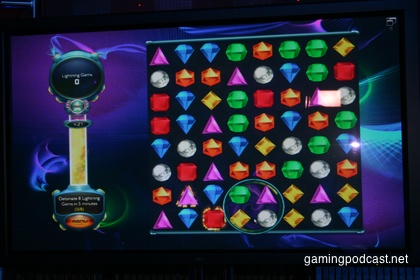
Stay tuned for the full review as we get deep into the full features of Bejeweled Twist. Special thanks to Dale North from Destructoid for hanging out for some drinks during the after party.
0 thoughts on “Bejeweled Twist Launched, Casualites Rejoice”

Leave a Reply

Your email address will not be published. Required fields are marked *

Related Post

Episode 373: Happy New 2015Episode 373: Happy New 2015

This is the first podcast of 2015, and Jonah and Paul are ready to get going, talking about their holiday gifts and their disappointment in the film Birdman. There’s no Gaming History or Gaming Flashback this week, but stay tuned for one next week.

The news in this episode includes:

  • FBI claimed to be investigating Xbox Live, PlayStation Network DDoS perps
  • GSC Gameworld re-opens for business
  • Halo 5 multiplayer beta gets more maps, weapons, and modes (from GameSpot)
  • Xbox Live founder leaves Microsoft

Also in the podcast is some Listener Feedback and the Question of the Week, “How much do you play online?”

Episode 319: Someone Is Butt-Hurt About MicrosoftEpisode 319: Someone Is Butt-Hurt About Microsoft

There’s no Gaming Flashback or Gaming History, but there is a crapton of news this week on TD Gaming Podcast, which Jonah Falcon and Jordan Lund eagerly read.

That, and Jordan really wants to know what you have been playing.

The news this week includes:

  • Microsoft officially announces indie self-publishing, to be unveiled at GamesCom 2013
  • Phil Fish explodes on Twitter, cancels Fez II in a huff
  • Shadow of the Eternals back on Kickstarter, no longer episodic
  • Neil Gaiman has announced his first videogame, Wayward Manor
  • Lanning: Nintendo will be around for “100 years,” but probably not Zynga or Microsoft
  • Activision-Blizzard buys out $8.2B of its own stock from Vivendi
  • Paid subscribership of World of Warcraft down to 7.7M

All this and Listener feedback.

Evolution of RPG’s – Gamers Don’t Want an End?Evolution of RPG’s – Gamers Don’t Want an End?

I remember a day when old RPG games had either a level cap or a definite ending. From Pool of Radiance to Secrets of the Silver Blades to Final Fantasy the game had a final boss or stage and often had some type of level cap. Today, gamers don’t want it to end, they’d rather have the option to wonder around aimlessly or completing minor quests in order to soak up every ounce of money they spent on the title.

linkNow even Bethesda is saying “we’ve learned our lesson” from the whiplash of ending their game title and capping levels. Gamers want to go back and re-try content they missed, they want to run side quests and talk to everyone in the world they want to grind themselves to über powerful levels and become a god in their fantasy world. Can you blame them?

You can’t really blame them for wanting to maximize the content, although it’s slightly more evolved than RPG’s of old. Perhaps it was World of Warcraft and other MMORPG’s that brought us to the stage in life where we all want to squeeze every last RPG dime out of the title. As a kid I wondered the world of Hyrule and covered every tile of graphical color, burned every bush, bombed every stone looking for all the content. However, even Zelda had an end with scrolling credits – you didn’t just land on a platform with your master sword and a dream.

Other titles have used level caps to limit you and draw you into the next release of the game. This was popular in the D&D world because the game is designed to target specific levels of difficulty. They may only allow you to gain level 10 because the enemies are no tougher than level 13, allowing the challenge to be good but not overwhelming. If they allow you to get to level 50 they’d have to design the game so all the enemies grow powerful along with you — that’s not always a desired result.

Final Fantasy is a popular franchise that typically allows you to grow infinitely powerful depending on how much time you want to spend repeat killing the same enemies. Gamers aren’t always into the grind, they just want to grind “enough” to make the challenges a little more do-able.

Today, however, with larger storage capacity, larger development teams and the desire to build more value into your gameplay experience titles have dozens of side quests and sub-plots that are totally optional. The result of so many sub-quests results in a player who is much more powerful at the end of those quests compared to a player who sticks to the narrow path of the main plot. So, games much grow dynamically challenging to keep the fun per dollar high.

Do you like your RPG’s to have a definite end and a high but capped level?