
Gaming Flashback: Yo! Noid

Yo! Noid was a commercial opportunity for Domino’s Pizza developed by Capcom. This retro style game revolved around Domino’s Pizza claymation style mascot, the Noid, as he adventures through fourteen stages of side scrolling action.
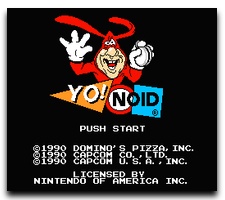
The game sound was much like any other 8-bit action platformer. It reminded me of the original Teenage Mutant Ninja Turtles for the Nintendo Entertainment System, not the cool arcade one. Minus the turtles, Yo! Noid is a battle against Mr. Green, the Noids evil duplicate, a concept used in so many games; remember Shadow Link?

Unlike Link, Noid lost a life when he hit an enemy similar to the Super Mario Bros. style platformer but with a Yo Yo weapon. You could also gather smart-bomb type scrolls to clear the screen of all enemies, another classic side scroller arcade recipe. Yo! Noid brought nothing to the table in terms of uniqueness and relied on the standard recipe of side scrolling conflict.

This retro game may be one of the first true “total conversion mods.” Later we’d see Counter Strike born out of the Half-Life engine and way before that, Noah’s Ark 3D built out of the Wolfenstein 3D engine. Yo! Noid was a re-creation of the game Kamen no Ninja Hanamaru. Oddly enough, Yo! Noid was probably more well known than its forefather game because Capcom didn’t release Kamen no Ninja Hanamaru in the United States. Instead, we got Yo! Noid and a $1.00 off coupon on the back of the manual so we can get ourselives some Domino’s Pizza.

Although a few of us may recall Yo! Noid from our childhood, the title really didn’t create any huge waves in the game industry. Yo! Noid did show developers that a brand named product could be used as a marketing and brand awareness strategy, something we’d later see Burger King try on the Xbox 360 and find some success.

Can you tell the difference between Yo! Noid and Kamen no Ninja Hanamaru?

Leave a Reply

Your email address will not be published. Required fields are marked *

Related Post

EA Listens To The Public: No SecuROM In The Sims 3!EA Listens To The Public: No SecuROM In The Sims 3!

simsIt seems Spore was the staging point for the SecuROM revolt and the massive amazon 1-star reviews and backlash have not gone on deaf ears. Electronic Arts has opted to leave SecuROM out of The Sims 3, an upcoming release for just that reason.

“We have heard your requests over the past months and here is our plan for The Sims 3,” Sims development head Rod Humble stated on the official website. “The game will have disc-based copy protection – there is a serial code just like The Sims 2. To play the game there will not be any online authentication needed. (casualgaming.biz)

We wonder, did they do this primarily because of the Spore revolt or because the demographic for The Sims is even more casual than that of Spore? Casual gamers expect a casual experience from install to un-install because they don’t want to be hassled with silly copy protection. Or, perhaps casual games like The Sims is less likely to be hacked because it’s not a “hardcore” game?

We’re sticking with the thinking that this is a “good faith” jesture to the gamers for how they “rocked the vote” on the last title as The Sims is one of the best selling series on the PC gaming platform. Lots of sales with lots of fans, why interrupt that momentum with ugly DRM whiplash?

Developer Wants License Keys For Console GamesDeveloper Wants License Keys For Console Games

UK developer David Braben from Frontier Developments believes smaller development studios are in the worse position when it comes to re-sale of “pre-owned” video games. Since a developer only gets their cut of the profits when a game is sold new, pre-owned titles allow gamers to play games without paying the developer for the effort.

This also hurts larger publishers, but they’re able to recover because of the sheer volume of games and game titles. One idea David had, was to code each game with a unique license key like a PC game that gamers must enter before playing. This would kill the ability to re-sell video games back to the market for others to buy at a cheaper price (translation: better value).

The future shows a higher degree of downloadable games, which cannot be re-used or sold back to the market, but for now, developers have to deal with pre-owned video games cutting into their profit. Presumably you could have a great game with smaller sales and a high degree of resale in the pre-owned market.

Problem with this take on development? Besides large scale video game sellers like GameStop making 80% profit margins on resold games (rather than a 10-15% on new), gamers want a way to make back some of their money on expensive titles. When you’re paying $60 for a game and you beat it in a week or two, you want to resell it so you can invest in a future title.

My theory… make games more affordable so we don’t feel gouged on the price. We may decide to hold on to it longer and tell our friends about it. A good game reference and a reasonable price will increase sales every time. Don’t try to solve pre-owned problems when the problem is the publisher and the industry making huge game prices.

(Thanks, Kotaku)

Episode 590: Microsoft and Epic Tag TeamEpisode 590: Microsoft and Epic Tag Team

This week has Microsoft backing Epic against Apple, Nintendo telling people they don’t have controller drift and apologizing for controller drift, and some new games.

The news includes:

  • Level-5 has reportedly halted nearly all operations in North America
  • Microsoft sides with Epic in its fight with Apple
  • Nintendo is reducing the price of Switch Joycons in Japan
  • Torchlight 3 leaves Early Access

Let us know what you think.