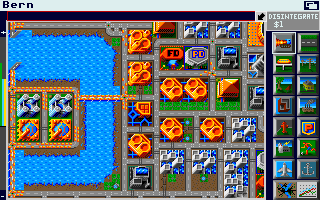
 SimCity was released in 1989, was originally called Micropolis and was designed by the infamous Will Wright. For those that don’t know Will Wright, its suffice to say he’s one of the most popular and influential game designers of our time. SimCity, TheSims, SimAnt, SimFarm and Spore are a few of his hits and TheSims has taken many records since its original release.
Wright had trouble finding a publisher for a game in which you couldn’t really “win or lose.” Turned down by Broderbund, Wright eventually pitched the idea to Jeff Braun of Maxis. Maxis agreed to publish Simcity as one of its first two games.
When near complete, Wright and Braun took the game back to Broderbund to clear the rights for the game. Broderbund executives Gary Carlston and Don Daglow saw how addicting the game could be and signed Maxis to a distribution deal. Four years after initial development, SimCity was released for the Amiga and Macintosh platforms, followed soon after by the IBM PC and Commodore 64. On January 10th 2008, the SimCity source code was released under the GPL license as… Micropolis!
The objective of the game is simple, build and design a city. Though the player could focus on building a highly efficient city with an ever growing populace, it was by no means required. In a sense, open ended, the player was free to design the city as they chose.
Included in the city building experience was the possibility of natural disasters such as flooding, tornadoes and more. Pre-designed scenarios were also included in the game such as the Boston 2010 nuclear meltdown, or mass coastal flooding of Rio de Janeiro of 2047 … even a Godzilla attack of Tokyo in 1961.
In the years to follow, the SimCity franchise would continue to expand with greater detail as SimCity 2000 (1993), SimCity 3000 (1999), SimCity 4 (2003) and a host of other “Sim” games and until the release of “The Sims” in 2000, the SimCity series was the best-selling line of games made by Maxis.
In Fall of 2008, EA will release the next child in the SimCity family, SimCity Creator for the Nintendo Wii and DS systems. And thus, history continues!