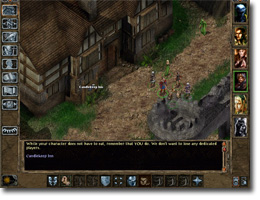
 Baldur’s Gate isn’t too old, it was released in November of 1998, but that’s still a bit dated now. The gaming industry isn’t friendly to the years, often working in what seems to be accelerated “dog years” in terms of technological advancements. It figured this was worth covering because it’s one of the best selling and considered a top tier single-player RPG by most accounts.
It was also developed by BioWare, who, at the time, only had one other game under their belt from two years before called Shattered Steel.
The story begins just after a devastating event in the Forgotten Realms D&D campaign called the “Time of Troubles.” This was a great twist in the standard D&D campaign, it caused all curative magic (clerics) to lose their ability to heal unless near their deity, magic didn’t function correctly (I believe this is where the Wild Mage came from) and was unpredictable and gods walked the earth as mortals which caused magic to, in effect, die while the gods were away. Since the storyline starts slightly after this event, the game contains healing and magic but the storyline is impacted by prior events of course, people have trust issues.
The game was made great because it held “mostly true” to the 2nd Edition D&D roots so the learning curve for D&D player’s wasn’t so rough; some things were adjusted to handle the real-time effect of a video game RPG. You could party with up to six Non-Player-Characters (NPC’s) whom would swap in and out of your active party over time as part of the storyline (something also implemented by the US release of Final Fantasy 2).
(more…)
Podcast: Play in new window | Download