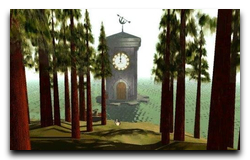
 Myst was published by Brøderbund Software, developed by Cyan Worlds and created by two brothers that did the design and directed the game (it was, much like a movie).
The original game was released on the Macintosh (in 1993) and then later ported to Microsoft Windows and Sega Saturn, PlayStation, Jaguar CD, AmigaOS, CD-i, 3DO, PlayStation Portable, and Nintendo DS.
“Myst puts the player in the role of the Stranger, who uses an enchanted book to travel to the island of Myst. There, the player uses other special books written by an artisan and explorer named Atrus to travel to several worlds known as “Ages”. Clues found in each of these Ages help reveal the back-story of the game’s characters. The game has several endings, depending on the course of action the player takes.” (wikipedia)
The game was a success, no doubt, and was considered the best selling PC game of all time until TheSims dethroned it. Besides mind blowing graphics, at the time, Myst helped move the game and PC industry along by selling CDROM’s. The game required a CDROM, which was rare at the time, and I recall them bundling Myst with some CDROMS or hyping it as “you need a CDROM so you can play Myst.” On more than one occasion when a person game to me asking what they should get to show off their new (costly) CDROM I would say “you need to try Myst.”
The gameplay of Myst consists of a first-person journey through an interactive world. The player moves the character by clicking on locations shown in the main display; the scene then crossfades into another frame, and the player can continue to explore. Players can interact with specific objects on some screens by clicking or dragging them(wikipedia)
Franchise sales: 12-million copies (first Myst game alone in the franchise, 6-million), pretty impressive eh?
You don’t have to be a huge Myst fan to know how it changed the industry, grew the medium of CD-based games and entertained millions. A real gamers thinking game!
To hear our full impression of Myst, checkout the TD Gaming Podcast Episode 77.
Podcast: Play in new window | Download

 Microsoft Xbox 360 Outsells PS3 and Wii in Japan
The Japanese didn’t buy the Xbox 360 on Star Ocean: The Last Hope alone that week. It was more like, “Oh, an exclusive Star Ocean. That tears it. I was on the bubble with Blue Dragon and Tales of Vesperia and some of the other 360 RPGs that I was interested in, but now Star Ocean, too? I’ll pick this up, get Ocean, then get Blue Dragon and the other games that piqued my interest but weren’t enough for me to buy a 360.” Sort of like you and the PS3, Derrick. Yes, you covet LittleBigPlanet, but it alone isn’t enough. You’re waiting for your PS3 Star Ocean (and Killzone 2 isn’t it.)
The Japanese didn’t buy the Xbox 360 on Star Ocean: The Last Hope alone that week. It was more like, “Oh, an exclusive Star Ocean. That tears it. I was on the bubble with Blue Dragon and Tales of Vesperia and some of the other 360 RPGs that I was interested in, but now Star Ocean, too? I’ll pick this up, get Ocean, then get Blue Dragon and the other games that piqued my interest but weren’t enough for me to buy a 360.” Sort of like you and the PS3, Derrick. Yes, you covet LittleBigPlanet, but it alone isn’t enough. You’re waiting for your PS3 Star Ocean (and Killzone 2 isn’t it.)
Long time listener, first time commenter. Really love your show, thanks and keep it up.
In regards to your discussion relating to what MMO’s need to do break into a market dominated by WoW, a good concept that I believe would work well with many of the more recent MMO releases is the strategy used by Dofus (the french 2.5D flash based MMO) .
Dofus allows all users to play for free but they are restricted to the beginning area and the area surrounding the first major town. This includes the first dungeon which by itself is addictive enough to play hundreds of times over in the hope for some great beginners loot and quest rewards. There are also a few other restrictions for Free-to-play characters, such as being unable to see items via the shop mode and decreased chances of getting rare loot.
The game is well designed and very diverse in character play styles, but having over 10million users and over 1 million paid players, shows that this strategy may have more potential long term rather than the short term subscribe form the beginning cash boost with only 10 day free trials which tend teeter out and diminish in profitability as time goes on.
For a game such as AoC, Warhammer or LotR Online, a system where players could play for free forever but if they want to go beyond the the first 20 levels (or a 1/3 of total cap depending on how many levels are available) they have to subscribe may reduce initial income from the game but help games to gain more sustainability and secure a longer term future. You would expand your base of potential customers with all those trying it as it’s free, and as they get to experience or see paying customers enjoying some of the great features of the game, it would encourage the to move onto subscription.
With a larger player base (including all the free-to-play customers), it would also create a better gaming atmosphere and make it friendlier to new players with grouping being easier and full servers. Just my thoughts on the issue.
Once again thanks for the great podcast. Looking forward to the next one ^.^
Long time listener, first time commenter. Really love your show, thanks and keep it up.
In regards to your discussion relating to what MMO’s need to do break into a market dominated by WoW, a good concept that I believe would work well with many of the more recent MMO releases is the strategy used by Dofus (the french 2.5D flash based MMO) .
Dofus allows all users to play for free but they are restricted to the beginning area and the area surrounding the first major town. This includes the first dungeon which by itself is addictive enough to play hundreds of times over in the hope for some great beginners loot and quest rewards. There are also a few other restrictions for Free-to-play characters, such as being unable to see items via the shop mode and decreased chances of getting rare loot.
The game is well designed and very diverse in character play styles, but having over 10million users and over 1 million paid players, shows that this strategy may have more potential long term rather than the short term subscribe form the beginning cash boost with only 10 day free trials which tend teeter out and diminish in profitability as time goes on.
For a game such as AoC, Warhammer or LotR Online, a system where players could play for free forever but if they want to go beyond the the first 20 levels (or a 1/3 of total cap depending on how many levels are available) they have to subscribe may reduce initial income from the game but help games to gain more sustainability and secure a longer term future. You would expand your base of potential customers with all those trying it as it’s free, and as they get to experience or see paying customers enjoying some of the great features of the game, it would encourage the to move onto subscription.
With a larger player base (including all the free-to-play customers), it would also create a better gaming atmosphere and make it friendlier to new players with grouping being easier and full servers. Just my thoughts on the issue.
Once again thanks for the great podcast. Looking forward to the next one ^.^