
Retro FlashBack: DragonFire (Atari 2600)

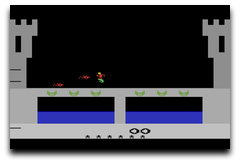
Now here is another interesting video game for the Atari 2600, the game Dragon Fire consisted of two game screens, one which you ran across a bridge while fireballs were shot at you, you had to duck or jump over the fireball. This screen was a side-scroller style screen (although it doesn’t actually scroll), at the other end of the bridge was a castle door which you’d enter to get to the next screen.

The second screen was more classic “overhead but not really” screen where you ran around this black screen picking up treasures while a dragon at the bottom shot fire at you from below.

As the game increased in level jumping fireballs became more challenging (on the first screen) as you ran because they would come quicker, more often. The second screen would get very difficult very quickly as the dragon would increase in speed and fireball spitting. You could tell how hard the dragon would be as it would change colors from lighter to darker black as you progress stages.
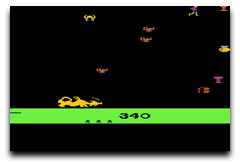
When you finished collecting all the treasure an exit would pop up in the corner and you had to run to it without being burned by the fireballs, that dragon would turn from left to right nearly instantly too! Then, you’d jump into the exit and be back on the bridge again, but this time it was harder. You could die up to 7 times before the game was over (just to show you how hard it is, they gave you a bunch of lives).

The game was tough, frustrating, hard to replay because you were just so nervous and jittery from the last attempt. Graphics were “okay,” nothing to rave at but it was, after all, the 2600.

You can hear all we had to say about DragonFire for the Atari 2600 on Episode 79 of the TD Gaming Podcast!

0 thoughts on “Retro FlashBack: DragonFire (Atari 2600)”

Leave a Reply

Your email address will not be published. Required fields are marked *

Related Post

ID Software, Not Just One Game AnymoreID Software, Not Just One Game Anymore

As Bob Dylan once wrote, “The times they are a-changin'” and id Software may be ready to change with these times. They’re talking at Quake Con about both DOOM 4 and their next title Rage (a first person shooter car driving game) both utilizing the same engine, the Tech 5 engine, and being developed simultaneously.

Now, this doesn’t mean you’ll have dual release games but it shows that id Software is ready to work on more than a single project at the same time, a big step for them. Although they’re usually working a big engine while finishing up a title to run on such an engine, they’ve got two titles in the works. This is very unlike the little FPS company but it shows they’re ready to meet the challenge of a larger industry.

When the original DOOM arrived there was nothing to compete against them and through the years and into Quake their competition was light years behind. Developers like Epic Games, Bungie and other first-person-shooter genre developers have proven themselves in the industry with many titles and sequels while id releases, seemingly, one game every five years.

For a company with only one or two franchise titles they do take a long time to release another game. This may be due to their engine licensing, no longer under the “Quake” engine name and sticking with its own independant naming convention like ID Tech 4 and ID Tech 5, they’re showing us the company is about engine design seperate from any demos or game prototypes they provide to show off the engine.

To many gamers DOOM 3 was more of a prototype to show people how far graphics have advanced in the last twenty years. Many folks were excited to play but grew bored when they realized it was very much like DOOM 2 but with a graphic revamp. Nostalgia only goes so far before you realize the story and depth behind games like Half-Life, Unreal and Halo have far exceeded a extreme graphical FPS gaming.

It’s time for id to grow from their roots and expand into many game genre’s and build out new independent properties (like Rage) to show the industry they’re not just a one-hit wonder with a huge fan base.

But, you can’t argue with a huge fan base. They’ve got a full conference to show off their stuff, not even Electronic Arts has that!

(Thanks, 1up)

Wallets Shrink, Used Game Market GrowsWallets Shrink, Used Game Market Grows

Over the last year we’ve seen developers scrambling to find “value add” features to new game purchases. Their goal is to convince the customer to buy new instead of used because developers don’t see a penny from a used game sale. While GameStop sees 48% profit margins from the used game market developers struggle to stay floating in the industry.

for-saleThis is not the fault of GameStop and their 48% profit margins because they’re only getting 7% to 20% profit margins (say analysts) on new game sales. As someone that’s run a game store online, if you’re getting 15%+ on a new game you’ve got some great hookups in the distribution channel or are buying in huge quantities.

Buying games in huge quantities to build profit margins can be a huge mistake in this industry. Gamers are fickle little creatures and they’re going to buy their top tier games for a few weeks and then sales will drop significantly. No retail chain wants to purchase a thousand copies of GTA IV (only as an example) and sell seven hundred over the first few week to be stuck holding onto a few hundred copies when the dust settles. Now you’ll have to put them on sale to get them out of the store because the hardcore gamer have already done their shopping and you’re not going to get any price protection if you’re not a major player in the industry.

Why take 7% profit margins when you can get 48% on a used game? The gamers don’t seem to mind because they’ll trade in a used copy of a sports title like Madden to save $5.00 on the latest franchise release. Gamers will buy Fable 2, beat it in a week and rush to the store to get the “most for their dollar” before the game gets stale and buy-back prices drop like a stone. Why not rent Fable 2 and save yourself $50.00? Of course, renting pisses off developers as well because they see no additional revenue.

While the economy struggles and consumers fight for their jobs, the entertainment side of life continues to grow. People would rather “cocoon” in their homes playing video games and watching movies on their brand new HD television because it takes them away from the low points of the economy if only for a few hours. History has shown us trends in entertainment during the down points of economies, it’s natural to want to get away for a bit.

But, consumers want to play these games on the cheap because their job may not be there tomorrow. Saving $5.00 knowing the store just took the title in for half the price doesn’t bother you; $5.00 in your pocket is better than in their pocket right? The fact that they just pocketed upward of 40% on the game doesn’t matter to you — it’s all about your bottom line!

While we’re bargain hunting during the recession developers are going to try and up sell you to a new copy of the game. If that means giving you special game items and features with a “one time code” upon purchase, it will be up to you to decide if it’s valuable. All the while GameStop will lock out the game industry from selling used games because 42% of their overall gross profit is from used game sales.

You, the consumer, benefits from a slightly cheaper game, bargain bin fire sales and additional game features if you do choose to buy new. The economic down turn is a great time to be a gamer, as long as you remain employed.